🧪 How Perfume Works: The Science Behind Fragrance, Molecules, and Human Smell
Perfume has fascinated people for centuries. A single spray can evoke memories, change moods, and even shape how others perceive us. But have you ever wondered how perfume actually works?
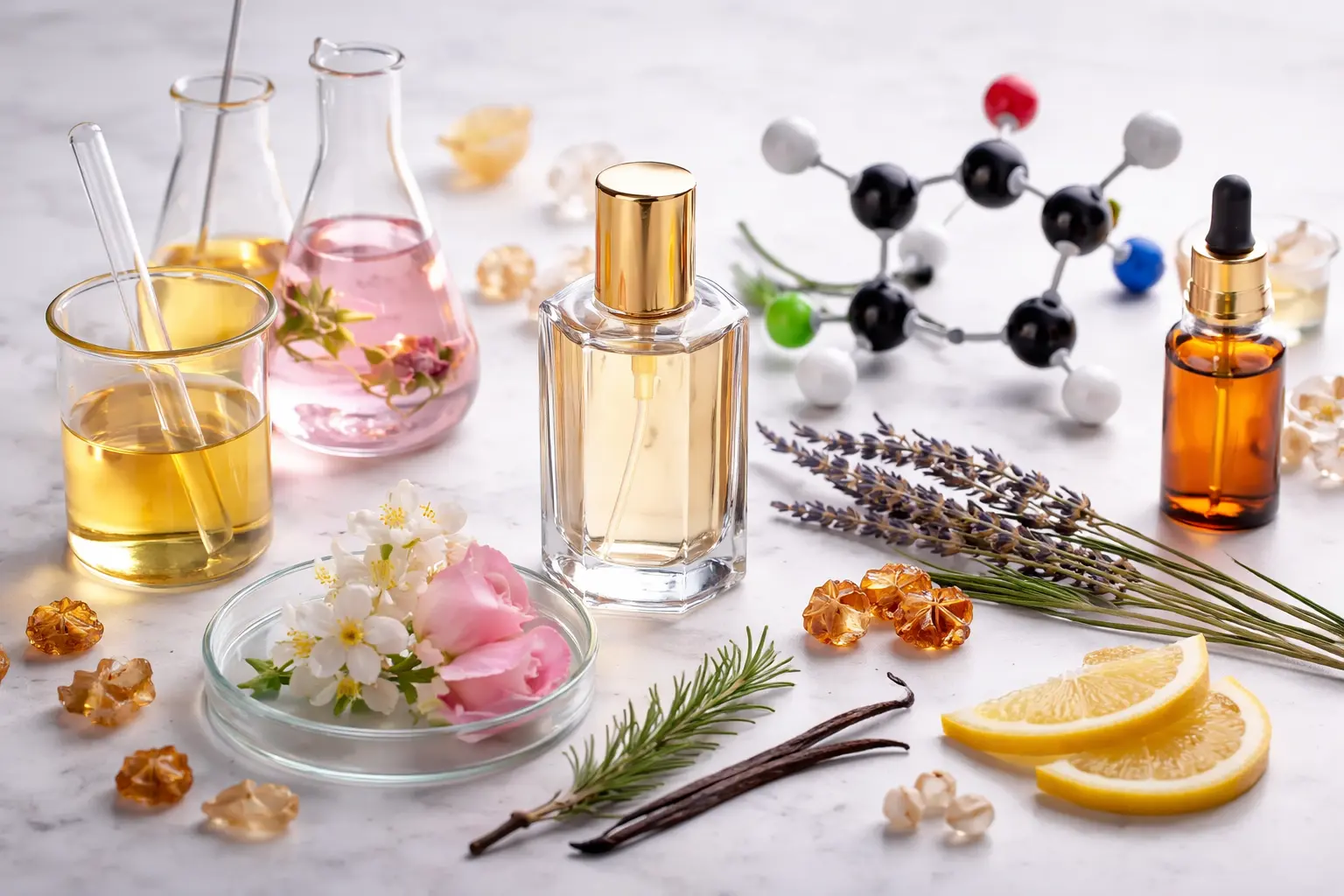
Behind every fragrance lies a complex interaction between chemistry, skin biology, air molecules, and the human brain. When you spray perfume, hundreds of aromatic compounds begin an invisible journey—evaporating, traveling through the air, and interacting with the receptors inside your nose.
Understanding how perfume works scientifically can help you choose better fragrances, apply them correctly, and make them last longer.
In this guide, we’ll explore the science of perfume, including how scent molecules travel, how the nose detects fragrance, and why perfumes behave differently on every person.
🌿 What Is Perfume Made Of?
Before understanding how perfume works, it helps to know what perfume actually contains.
Most perfumes consist of three core components.
| Ingredient | Role in Perfume |
|---|---|
| Fragrance oils | Provide the scent |
| Alcohol | Helps disperse and evaporate the scent |
| Water | Stabilizes and dilutes the mixture |
The fragrance oil portion is where the magic happens. These oils contain dozens or even hundreds of aromatic molecules, each contributing to the overall scent.
Perfume ingredients can come from:
- Natural sources like flowers, woods, spices, and resins
- Synthetic aroma molecules created in laboratories
- Hybrid blends combining both
Modern perfumes often rely heavily on synthetic fragrance molecules because they are more stable, affordable, and sometimes impossible to obtain naturally.
👉 Ever wondered why your favorite perfume sometimes smells sharp or “chemical”? Discover the surprising reasons in Why Does Perfume Sometimes Smell Chemical? — and learn what’s really happening on your skin.
🔬 The Moment You Spray: What Happens First?
When perfume leaves the bottle, a fascinating chemical process begins.
The atomizer turns liquid perfume into tiny airborne droplets. These droplets quickly spread across the skin and start evaporating.
This is where alcohol plays an important role.
Alcohol evaporates rapidly, helping lift fragrance molecules into the air. This process allows the scent to become noticeable almost instantly.
At this early stage, perfume can smell slightly sharp or alcoholic because the alcohol evaporates faster than the fragrance oils.
If you want a deeper explanation of this phenomenon, you may enjoy reading our detailed article:
👉 Why Does Perfume Smell Like Alcohol at First
That guide explores the chemistry behind the initial scent burst many people notice when applying fragrance.
💨 The Science of Evaporation in Perfume
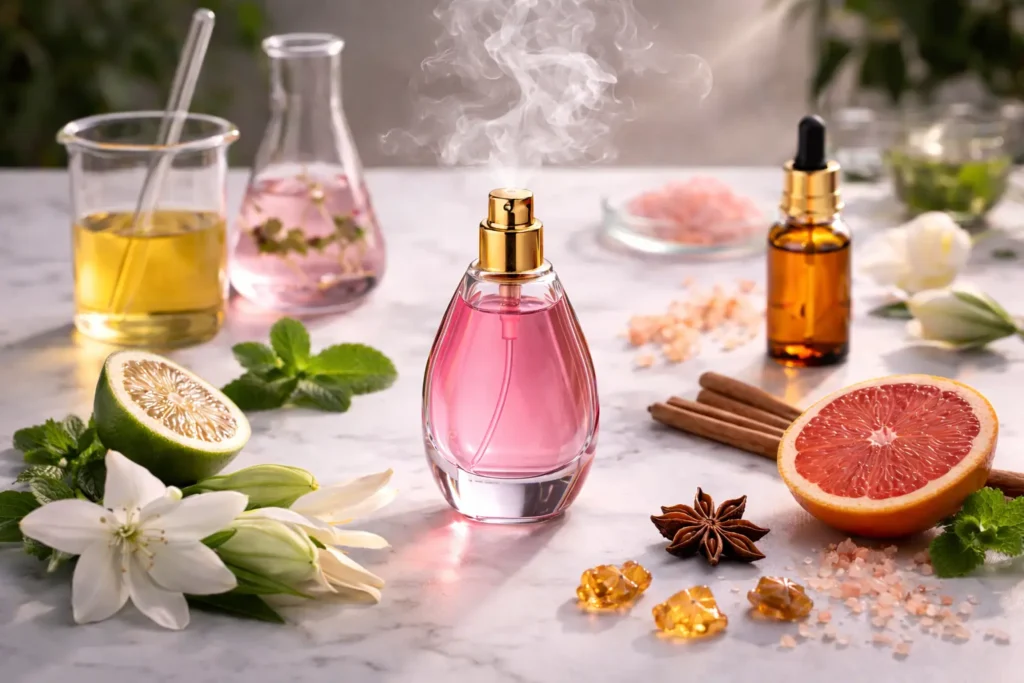
Perfume works primarily through evaporation.
Every fragrance ingredient has a different molecular weight and volatility, meaning some molecules evaporate quickly while others linger.
Light molecules evaporate first, while heavier ones remain on the skin longer.
This gradual evaporation is what creates the changing scent experience throughout the day.
Perfume evaporation occurs in three stages:
- Immediate release into the air
- Slow diffusion around the wearer
- Final lingering scent on skin and clothing
Environmental conditions such as temperature, humidity, and airflow can greatly influence this process.
For example:
- Warm weather speeds up evaporation
- Dry air can make perfume fade faster
- Moisturized skin slows evaporation
👃 How the Human Nose Detects Perfume
Perfume works only because of the incredible capabilities of the human olfactory system.
Inside your nose are approximately 400 types of odor receptors capable of detecting thousands of scent molecules.
Here is how the process works.
Step 1: Scent molecules enter the nose
As fragrance molecules evaporate, they travel through the air and enter the nasal cavity when you breathe.
Step 2: Molecules bind to receptors
These molecules interact with odor receptors located in the olfactory epithelium, a specialized tissue inside the nose.
Each receptor responds to different molecular shapes.
Step 3: Signals reach the brain
The receptors send electrical signals to the olfactory bulb, which then communicates with parts of the brain responsible for:
- memory
- emotion
- recognition
This is why certain perfumes can trigger vivid memories or emotional reactions.
👉 Ever wondered why some fragrances leave a powerful scent trail while others stay close to the skin? Discover the answer in Why Do Some Perfumes Project More Than Others? The Science of Sillage — and learn what makes a scent truly noticeable.
🧠 Why Perfume Is Strongly Linked to Memory
Unlike other senses, smell has a direct connection to the brain’s limbic system, which controls emotions and memory.
This is why fragrances can instantly remind you of:
- childhood memories
- specific places
- particular people
- important life moments
Psychologists call this phenomenon the Proust Effect, where scent triggers detailed recollections from the past.
Perfume brands often design fragrances to evoke specific emotional experiences, such as:
- comfort
- nostalgia
- luxury
- excitement
🌡️ Why Skin Chemistry Changes How Perfume Works
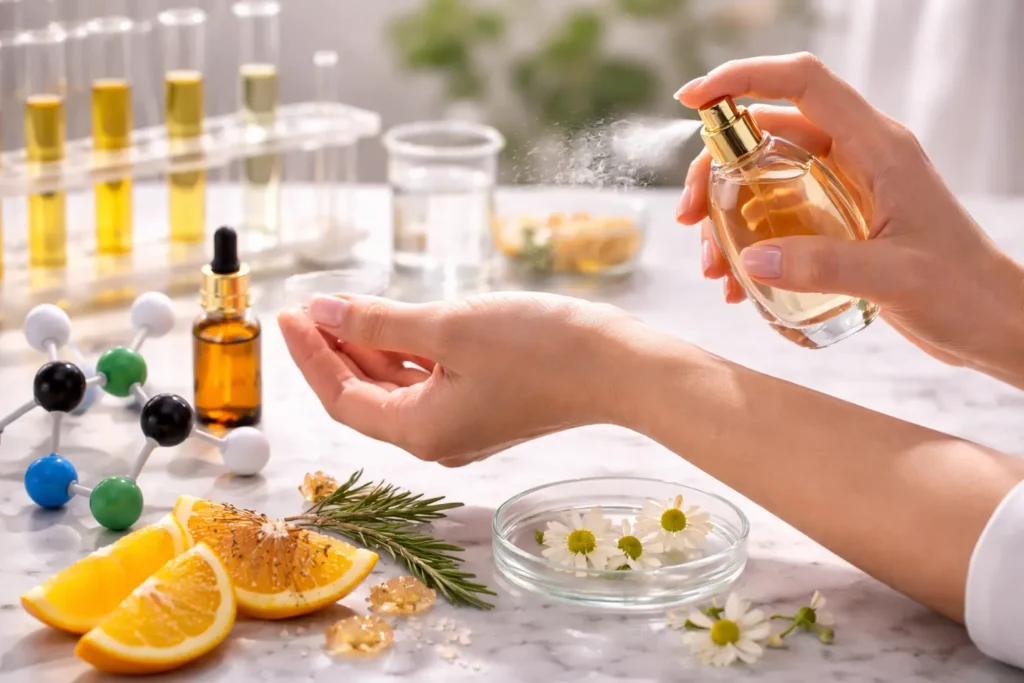
One of the most fascinating aspects of perfume is that it rarely smells identical on two people.
This happens because skin chemistry interacts with fragrance molecules.
Several factors influence this interaction:
Skin pH
Different skin acidity levels can alter how certain molecules behave.
Natural skin oils
Oily skin often helps perfume last longer because oils slow evaporation.
Body temperature
Warmer skin releases fragrance molecules faster.
Microbiome
The bacteria naturally present on skin can subtly modify scent molecules.
Because of these variables, perfume experts often recommend testing fragrances on skin rather than paper strips.
🧴 Why Moisturized Skin Holds Perfume Better
Dry skin absorbs perfume quickly, which can cause fragrances to fade faster.
Moisturized skin creates a surface where fragrance molecules can linger longer.
Many fragrance enthusiasts use techniques such as:
- applying unscented lotion before perfume
- spraying perfume on pulse points
- layering with matching body products
These methods help improve perfume longevity and projection.
🌬️ How Perfume Travels Through the Air
Perfume doesn’t stay fixed on your skin—it constantly moves through the surrounding air.
This movement is influenced by:
- air circulation
- temperature differences
- body motion
- clothing fabrics
When you walk past someone and they notice your fragrance, they are experiencing what perfumers call sillage.
Sillage refers to the trail of scent left behind as fragrance molecules disperse through the air.
High-quality perfumes often create a smoother and more elegant scent trail.
⏳ Why Some Perfumes Last All Day
Perfume longevity depends largely on the types of molecules used in the formula.
Certain fragrance ingredients naturally last longer than others.
Long-lasting fragrance ingredients include:
- amber molecules
- musks
- woods
- resins
Short-lived ingredients include:
- citrus oils
- light herbs
- delicate florals
Perfume concentration also plays a major role.
| Perfume Type | Oil Concentration | Typical Longevity |
|---|---|---|
| Eau de Cologne | 2–5% | 1–2 hours |
| Eau de Toilette | 5–12% | 3–5 hours |
| Eau de Parfum | 15–20% | 6–8 hours |
| Extrait de Parfum | 20–40% | 8+ hours |
Higher concentrations typically mean longer-lasting fragrance performance.
👃 Why You Sometimes Stop Smelling Your Own Perfume
A common experience among fragrance users is applying perfume and then feeling like it disappears quickly.
In many cases, the perfume hasn’t actually faded.
Instead, your brain becomes accustomed to the scent.
This process is known as olfactory adaptation or nose fatigue.
Your brain temporarily ignores familiar smells so it can detect new ones more easily.
If you want to understand this effect in greater detail, check out this related article:
👉Why Can’t I Smell My Own Perfume
It explains why fragrance wearers often become “nose blind” to scents that others can still detect.
🧵 Why Clothing Holds Perfume Longer Than Skin
Perfume tends to last longer on fabrics because clothing does not produce oils or heat like skin does.
Fabric fibers trap fragrance molecules and release them slowly over time.
However, some delicate fabrics can be sensitive to perfume oils.
Perfume lovers often spray fragrance on:
- scarves
- jackets
- sleeves
- hairbrushes
This technique can significantly increase fragrance longevity.
🌎 Environmental Factors That Affect Perfume Performance
Even the best perfume behaves differently depending on environmental conditions.
Several external factors influence how perfume works.
Temperature
Heat accelerates evaporation, making perfumes smell stronger but fade faster.
Humidity
Moderate humidity can help fragrance linger in the air longer.
Air circulation
Wind or airflow disperses scent molecules quickly.
Sunlight
Direct sunlight can break down fragrance molecules and damage perfume over time.
Understanding these factors helps explain why your favorite fragrance may behave differently in summer versus winter.
🧬 The Role of Synthetic Molecules in Modern Perfume
While many people imagine perfumes made entirely from natural ingredients, modern perfumery relies heavily on synthetic aroma molecules.
These molecules offer several advantages:
- consistent scent quality
- longer shelf life
- greater stability
- ability to create entirely new scent profiles
Some famous synthetic molecules include:
- Iso E Super
- Ambroxan
- Hedione
These molecules can enhance projection, diffusion, and longevity in fragrances.
🏭 How Perfumers Design a Fragrance
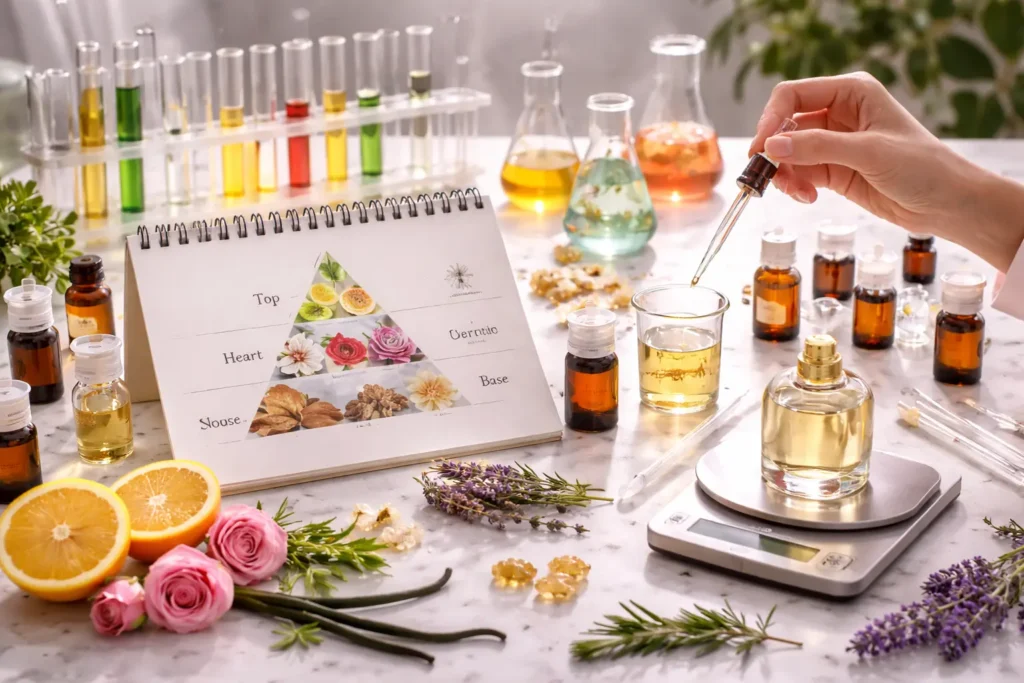
Creating a perfume is both a science and an art.
Perfumers, often called “noses,” combine fragrance molecules into carefully balanced formulas.
The process typically involves:
- Concept development
- ingredient selection
- multiple formula trials
- evaporation testing
- stability testing
A single fragrance may require dozens or even hundreds of revisions before reaching the final formula.
🧭 Why Understanding Perfume Science Helps You Choose Better Fragrances
Learning how perfume works gives you a powerful advantage when selecting fragrances.
Instead of relying only on brand names or marketing, you can understand:
- why certain scents fade faster
- why some perfumes project strongly
- how skin chemistry influences scent
- how environment affects fragrance performance
This knowledge makes it easier to build a fragrance collection that suits your personal preferences and lifestyle.
❓ Frequently Asked Questions About How Perfume Works
How does perfume actually work?
Perfume works through evaporation. When you spray a fragrance, alcohol and aromatic molecules begin to evaporate into the air. These scent molecules travel into your nose, bind to odor receptors, and send signals to the brain, which interprets them as specific smells.
Why does perfume smell stronger right after spraying?
Perfume often smells stronger immediately after spraying because alcohol evaporates quickly and carries lighter fragrance molecules into the air. As the alcohol disappears and heavier molecules remain, the scent gradually becomes smoother and more balanced.
Why does perfume smell different on each person?
Perfume can smell different on each person because of variations in skin chemistry, body temperature, natural oils, and even skin bacteria. These factors affect how fragrance molecules evaporate and interact with the skin.
Why do some perfumes last longer than others?
Perfume longevity depends on the concentration of fragrance oils and the types of ingredients used. Heavier molecules like woods, resins, and musks evaporate more slowly, allowing the fragrance to last longer on the skin.
Why can I stop smelling my own perfume after a while?
This happens because of olfactory adaptation, also known as nose fatigue. Your brain gradually ignores familiar smells so it can focus on new scents in the environment. Others around you can usually still smell the fragrance even if you cannot.
Does temperature affect how perfume works?
Yes. Heat speeds up evaporation, which can make perfume smell stronger at first but fade more quickly. Cooler temperatures slow evaporation and may help fragrance last longer.
Does perfume last longer on clothes or skin?
Perfume usually lasts longer on clothing because fabrics trap fragrance molecules and release them slowly. Skin produces heat and oils that cause perfume to evaporate faster.
💬 Final Thoughts
Perfume may seem mysterious, but behind every fragrance lies a fascinating blend of chemistry, biology, and human perception.
From the moment perfume leaves the bottle to the instant it reaches your brain, hundreds of tiny scent molecules are working together to create an experience that feels almost magical.
Understanding how perfume works scientifically reveals why fragrances evolve over time, why they smell different on each person, and why certain scents can stay with us for years in memory.
And now we’re curious:
What was the first perfume that truly amazed you when you smelled it?
Share your experience in the comments—fragrance lovers always enjoy discovering new scent stories.
Discover more from Perfume Cultures
Subscribe to get the latest posts sent to your email.




56 Comments