
The Science Behind Sillage: Why Some Perfumes Stay Noticeable All Day
Sillage is one of the most fascinating — and misunderstood — aspects of fragrance. You’ve probably experienced it without realizing: a subtle scent trail left behind as someone walks past, or a fragrance that seems to linger in a room long after its wearer has gone.
But why do some perfumes leave a powerful trail while others stay close to the skin? The answer lies in chemistry, physics, and even human perception.
🌫️ What Is Sillage — Beyond the Definition
Before diving into the science, it’s essential to understand the concept itself. If you need a foundational explanation, this guide on
What Is Sillage in Perfume? The Invisible Trail Explained
breaks it down in detail.
In short, sillage refers to the scent trail a fragrance leaves in the air, not just how strong it smells up close. It’s about movement, projection, and diffusion — not just intensity.
⚗️ The Molecular Science of Sillage
At its core, sillage is driven by how fragrance molecules behave once applied to the skin.
Perfume is made of volatile compounds that evaporate at different rates. The lighter molecules (top notes) evaporate quickly, while heavier ones (base notes) linger longer. However, sillage depends on more than just evaporation — it’s about how these molecules travel through the air.
To understand this deeper, you can explore
How Perfume Works: The Science Behind Fragrance, Molecules, and Human Smell
which explains how scent molecules interact with both air and the human olfactory system.
Key factors affecting molecular behavior:
- Volatility: Faster evaporation can increase projection temporarily
- Molecular weight: Heavier molecules linger but may project less
- Diffusion rate: Determines how far scent particles spread
👉 Strong sillage often comes from a balanced composition — not just strong ingredients.
💨 Diffusion vs Projection: The Hidden Mechanics
Many people confuse projection with sillage, but they are not the same.
- Projection: How far a scent radiates from your body
- Sillage: The trail it leaves behind as you move
A perfume can project strongly but leave a weak trail — or vice versa.
This happens because:
- Projection is influenced by initial evaporation
- Sillage depends on continuous release + air interaction
Think of sillage as a dynamic cloud, constantly forming and dissolving as molecules disperse.
⏳ Sillage vs Longevity: Why They’re Not the Same
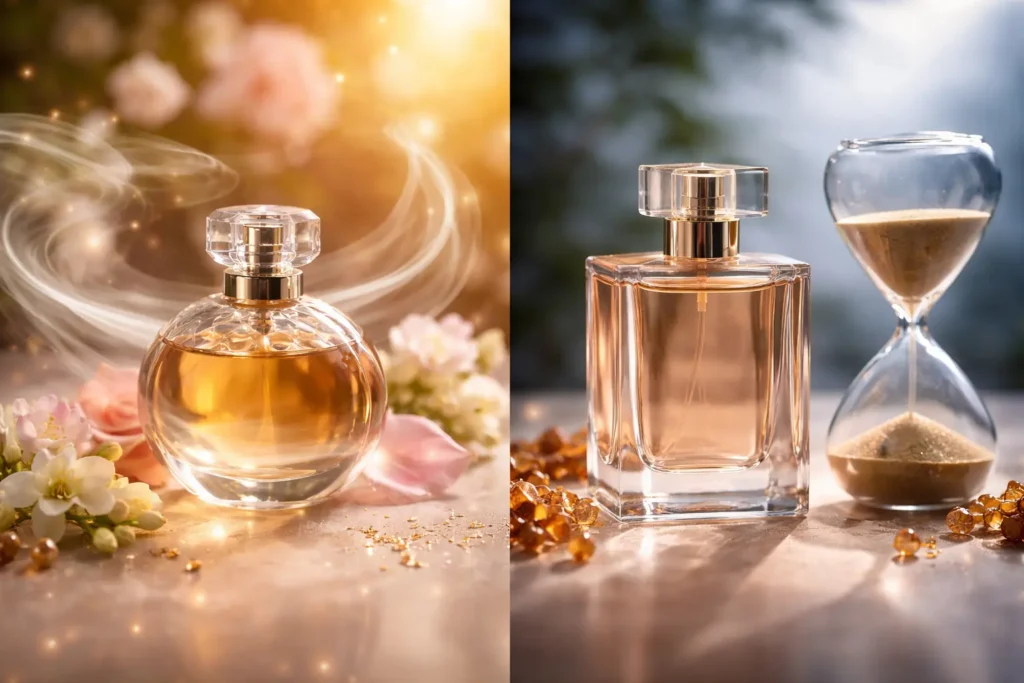
Another common misconception is that long-lasting perfumes always have strong sillage — but this isn’t true.
If you want a deeper breakdown, this guide explains it well:
How Long Does Perfume Last? Understanding Longevity, Skin Chemistry, and Fragrance Strength
The difference:
| Factor | Sillage | Longevity |
|---|---|---|
| Definition | Scent trail in the air | Duration on skin |
| Depends on | Diffusion & movement | Concentration & skin chemistry |
| Experience | Others smell it | You may still smell it |
👉 A fragrance can last all day but stay close to the skin — meaning low sillage, high longevity.
🧴 Skin Chemistry: The Invisible Variable
Your skin plays a critical role in how sillage behaves.
Factors include:
- Skin temperature (warmer skin = more diffusion)
- Oiliness (oily skin holds and releases scent differently)
- Hydration level (dry skin absorbs fragrance faster)
This explains why the same perfume can have completely different sillage on different people.
🎯 Application Technique: Small Changes, Big Impact
How you apply your perfume can dramatically change its sillage.
This detailed guide on
How to Apply Perfume Properly: The Right Way to Make Your Fragrance Last All Day
covers the fundamentals, but here are the key takeaways:
To enhance sillage:
- Apply on pulse points (neck, wrists)
- Spray on clothing (holds scent longer)
- Avoid rubbing (it breaks molecular structure)
- Layer lightly instead of over-spraying
👉 Sillage is not just built in the bottle — it’s shaped on your skin.
🧠 The Illusion of Weak Sillage (Nose Blindness)
Sometimes, the issue isn’t the perfume — it’s your perception.
If you stop smelling your fragrance quickly, it doesn’t mean others can’t. This phenomenon is explained in
Nose Blindness Perfume Explained: Why You Can’t Smell Your Own Fragrance
Your brain adapts to familiar scents and filters them out, making you “blind” to your own fragrance.
👉 This is why:
- You may think your perfume faded
- Others still notice it clearly
🌍 Environmental Factors You Can’t Ignore
Sillage doesn’t exist in isolation — the environment shapes it.
External influences:
- Temperature: Heat increases projection and diffusion
- Humidity: Can amplify or dampen scent spread
- Airflow: Movement carries scent particles further
A perfume that performs strongly indoors may behave very differently outdoors.
🧪 Fragrance Composition: The Real Secret
Ultimately, the formula itself determines sillage potential.
Ingredients known for strong sillage:
- Ambroxan
- Musk
- Patchouli
- Oud
- Resins (like amber)
These materials are often used in base notes because they:
- Evaporate slowly
- Diffuse consistently
- Create lasting scent trails
👉 This is why some fragrances feel “present” for hours without being overpowering.
❓ Frequently Asked Questions (FAQ)
1. Does stronger perfume concentration mean better sillage?
Not necessarily. Higher concentration improves longevity more than sillage. Diffusion depends on formulation, not just strength.
2. Why can others smell my perfume but I can’t?
Because of olfactory adaptation (nose blindness). Your brain filters out familiar scents over time.
3. Can I increase sillage without using more perfume?
Yes. Proper application, hydrated skin, and strategic placement can significantly boost sillage.
4. Do all long-lasting perfumes have strong sillage?
No. Some fragrances last long but stay close to the skin, creating minimal scent trails.
5. Why does my perfume perform differently in different seasons?
Temperature and humidity directly affect how molecules evaporate and diffuse in the air.
🔚 Final Thought
Sillage isn’t about how loud a fragrance is — it’s about how it moves, evolves, and leaves a memory behind.
Some perfumes don’t just smell good…
They exist in space, shaping how others experience your presence.
💬 Interactive Question
What matters more to you:
👉 A fragrance that lasts all day, or one that leaves a powerful trail wherever you go?
Discover more from Perfume Cultures
Subscribe to get the latest posts sent to your email.



One Comment