
Are “Mass Appealing” Perfumes Engineered to Be Safe?
In today’s fragrance market, certain perfumes seem universally likable. They’re clean, smooth, inoffensive—and rarely controversial. These are often described as “mass appealing” scents. But this raises an important question:
Are these perfumes naturally likable, or are they deliberately engineered to be “safe”?
The answer lies at the intersection of chemistry, psychology, and design strategy.
🧪 The Science Behind “Safe” Fragrance Design
To understand how perfumes become mass appealing, you first need to look at the fundamentals of scent construction. In How Perfume Works: The Science Behind Fragrance, Molecules, and Human Smell, we explore how fragrance molecules interact with olfactory receptors.
Mass appealing perfumes tend to rely on:
- Familiar molecular structures (e.g., musks, citrus aldehydes, ambroxan)
- Low volatility irritation (nothing too sharp or aggressive)
- Balanced evaporation curves (smooth transitions from top to base)
This is not accidental. Perfumers intentionally select molecules that:
- Trigger positive recognition
- Avoid sensory overload
- Maintain consistency across wearers
In short, these fragrances are chemically optimized for acceptance.
🎯 Smooth vs Harsh: Why Texture Matters
A defining trait of mass appealing perfumes is their smoothness. They rarely feel “rough,” “sharp,” or “challenging.”
As discussed in Why Some Perfumes Feel Smooth While Others Feel Harsh, this smoothness comes from:
- Blended transitions between notes
- Absence of polarizing ingredients (like heavy oud, animalics, or smoky accords)
- Use of “rounding” molecules like musk and vanilla
This creates a scent profile that feels:
- Soft on the nose
- Easy to process
- Non-threatening in social settings
Smoothness is not just a quality—it’s a design goal.
🧬 Predictability Across Skin Types
One of the biggest challenges in perfumery is variation. The same fragrance can smell very different depending on skin chemistry.
In Why Does Perfume Smell Different on Skin?, we explored how factors like:
- Skin pH
- Oil levels
- Body temperature
can dramatically alter a scent.
Mass appealing perfumes aim to minimize this variability by:
- Using stable aroma compounds
- Avoiding ingredients that react unpredictably
- Designing linear scent profiles
The goal is simple:
👉 Make the perfume smell “good enough” on as many people as possible
This is another layer of “safety”—predictable performance.
❤️ Emotional Universality: Playing It Safe with Feelings
Scent is deeply tied to emotion. In fact, as explained in Why Smell Is the Most Emotional Human Sense, our brains connect smells directly to memory and emotional processing.
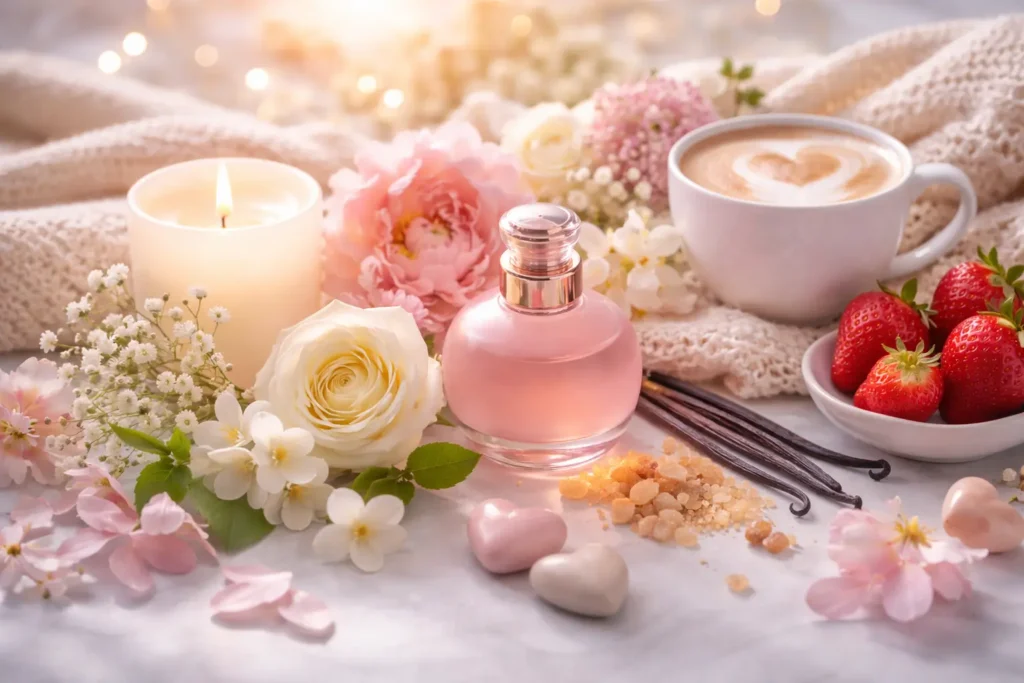
Mass appealing fragrances take advantage of this by using:
- “Clean” accords (fresh laundry, soap, citrus)
- “Comfort” notes (vanilla, tonka, soft woods)
- “Neutral attraction” profiles (light sweetness, subtle freshness)
These scents evoke:
- Familiarity
- Comfort
- Social acceptability
What they avoid:
- Confusion
- Intensity
- Emotional risk
👉 In other words, they are designed to feel good to most people—not deeply to a few.
🌫️ Controlled Presence: The Role of Sillage
Another key element of “safe” fragrance design is projection—how far the scent travels.
In What Is Sillage in Perfume? The Invisible Trail Explained, we learned that sillage determines how noticeable a fragrance is in the air.
Mass appealing perfumes typically feature:
- Moderate projection
- Soft scent trails
- Close-to-skin dry-downs
Why?
Because strong projection can:
- Overwhelm others
- Invade personal space
- Trigger negative reactions
So instead, these fragrances are engineered to:
👉 Be noticed—but never dominate
⚖️ The Trade-Off: Safety vs Character
While mass appealing perfumes excel at likability, they often sacrifice:
- Complexity
- Boldness
- Distinct identity
This doesn’t make them “worse”—but it does mean they are optimized for a different purpose:
| perfume goal | Result |
|---|---|
| Mass Appeal | High likability, low risk |
| Artistic Expression | Unique, but potentially divisive |
Safe perfumes aim to succeed in:
- Offices
- Social gatherings
- Everyday wear
Not necessarily:
- Artistic exploration
- Personal storytelling
🧠 Are They Engineered to Be Safe?
Yes—but not in a negative way.
Mass appealing perfumes are carefully designed to:
- Avoid offense
- Maximize acceptance
- Perform consistently
- Fit social norms
They are the result of:
- Scientific understanding
- Consumer psychology
- Market demand
Rather than asking if they are “too safe,” a better question is:
👉 What do you want your fragrance to do? Blend in—or stand out?
❓ Frequently Asked Questions (FAQ)
1. What makes a perfume “mass appealing”?
A mass appealing perfume uses familiar, smooth, and non-polarizing notes that are generally liked by a wide audience.
2. Are mass appealing perfumes lower quality?
Not necessarily. They are simply designed for broad acceptance rather than uniqueness or artistic complexity.
3. Why do niche perfumes feel more “risky”?
Because they often use unconventional ingredients, stronger projection, or more complex structures that not everyone enjoys.
4. Do mass appealing perfumes last less?
Sometimes. They often balance longevity with subtlety to avoid overwhelming others.
5. Is it better to wear a safe perfume daily?
It depends on your goal. Safe perfumes are ideal for daily use, especially in shared environments like work or public spaces.
Discover more from Perfume Cultures
Subscribe to get the latest posts sent to your email.




One Comment