
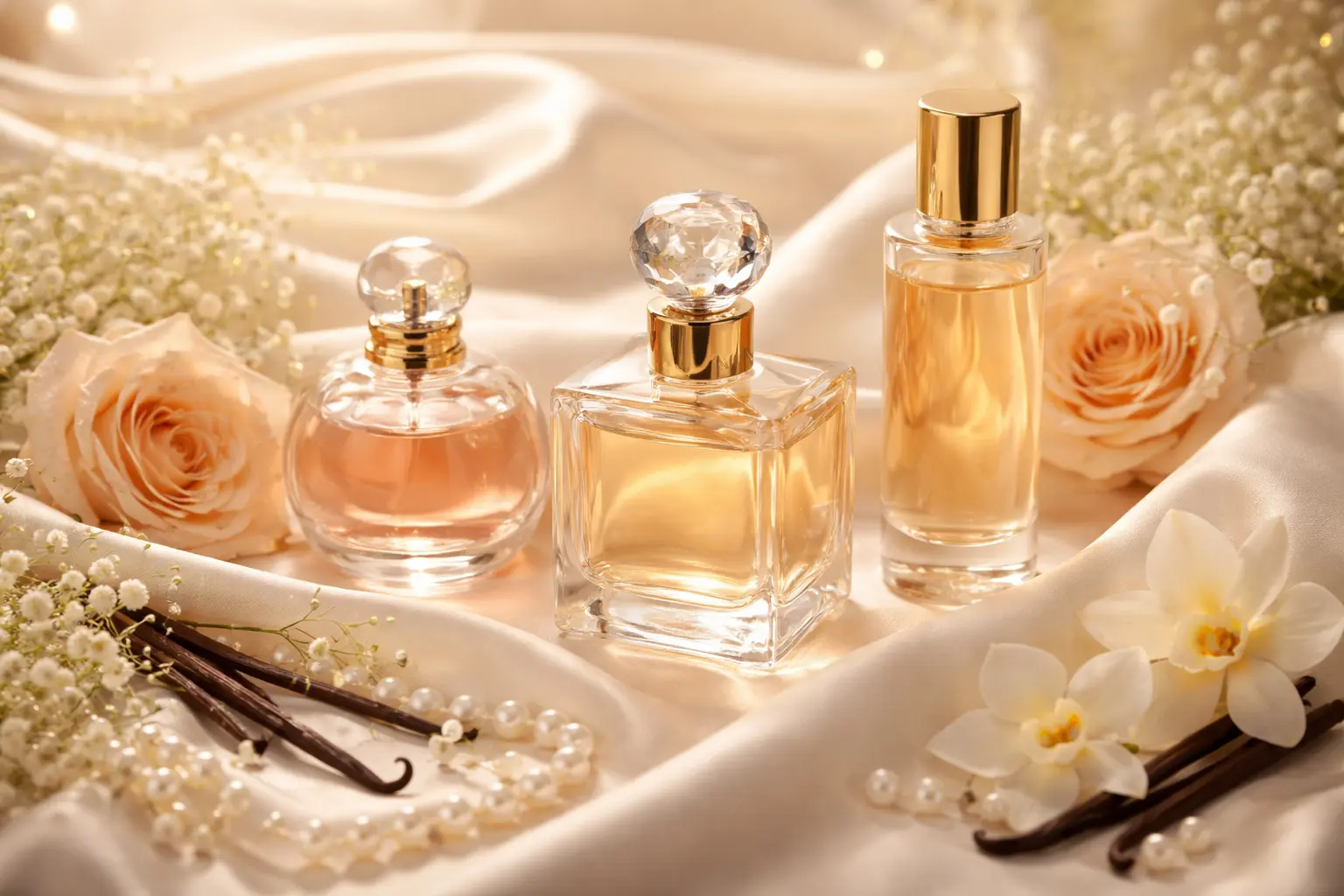
Why Some Perfumes Feel Smooth While Others Feel Harsh
Perfume is often described in emotional, almost tactile terms. A fragrance might feel smooth, creamy, or rounded—while another feels sharp, piercing, or even harsh. But what creates this difference?
This isn’t just subjective language. The perception of smoothness or harshness in perfume is rooted in chemistry, skin interaction, and the way the human brain processes scent.
Let’s break down what’s really happening.
🧪 The Molecular Structure Behind Smooth vs. Harsh Scents
At its core, every fragrance is a composition of volatile molecules that evaporate at different speeds. The way these molecules interact—and how smoothly they transition—plays a key role in how a perfume feels.
In How Perfume Works: The Science Behind Fragrance, Molecules, and Human Smell, we see that perfumes are structured in layers:
- Top notes (fast, bright, often sharp)
- Middle notes (balanced and expressive)
- Base notes (deep, smooth, long-lasting)
What creates “smoothness”?
- Well-blended transitions between notes
- Presence of base-heavy ingredients (woods, amber, vanilla)
- Balanced evaporation rates
What creates “harshness”?
- High concentration of volatile top notes (citrus, alcohol-heavy accords)
- Abrupt transitions between layers
- Synthetic sharpness without enough base support
A perfume feels smooth when the transitions are seamless. It feels harsh when the structure is fragmented.
🧬 Skin Chemistry: Why the Same Perfume Feels Different
Even a perfectly blended perfume can feel harsh on one person and smooth on another. That’s because your skin chemistry plays a major role.
As explained in Why Does Perfume Smell Different on Skin?, factors like:
- Skin pH
- Oil levels
- Body temperature
can dramatically change how a fragrance develops.
Example:
- On oily skin → base notes amplify → smoother perception
- On dry skin → top notes dominate → sharper, harsher feel
This is why testing a perfume on paper rarely tells the full story.
🧠 The Brain’s Role: Smoothness Is a Feeling, Not Just a Smell
Here’s where things get even more interesting: “smooth” and “harsh” are not strictly chemical properties—they are psychological interpretations.
In Why Smell Is the Most Emotional Human Sense, scent is shown to be deeply tied to the limbic system—the part of the brain responsible for emotion and memory.
What this means:
- A scent associated with comfort → perceived as smooth
- A scent linked to discomfort or unfamiliarity → perceived as harsh
So even identical chemical compositions can be experienced differently depending on emotional context.
🗣️ Why We Use Words Like “Smooth” and “Harsh” at All

Unlike vision or sound, smell lacks a precise vocabulary. We borrow terms from touch and emotion to describe it.
In Why We Struggle to Talk About Smell, this limitation is explored in depth.
Why this matters:
- “Smooth” doesn’t mean one exact thing chemically
- “Harsh” can refer to intensity, imbalance, or even personal dislike
These words are shortcuts for complex sensory experiences. They help communicate—but they don’t define the scent objectively.
🧍♂️ Personal Identity and Scent Preference
Interestingly, your preference for smooth or harsh fragrances may reflect your personality and identity.
As discussed in Perfume and Identity: The Invisible Expression, fragrance choices often align with how people see themselves—or want to be perceived.
General patterns:
- Preference for smooth scents → desire for warmth, comfort, subtle elegance
- Preference for sharper scents → desire for energy, boldness, presence
This makes the perception of smoothness not just sensory—but expressive.
⚖️ Smooth vs. Harsh: A Clear Comparison
| Feature | Smooth Perfumes | Harsh Perfumes |
|---|---|---|
| Transition | Seamless, blended | Abrupt, uneven |
| Notes | Base-heavy (woods, amber, vanilla) | Top-heavy (citrus, alcohol) |
| Skin effect | Enhanced by oils | Amplified by dryness |
| Emotional feel | Comforting, soft | Intense, aggressive |
| Perception | Balanced and refined | Sharp and attention-grabbing |
🧠 The Hidden Factor: Balance
Ultimately, the difference between smooth and harsh comes down to balance.
A perfume doesn’t need to be “soft” to feel smooth—it needs to be well-constructed. Likewise, a fragrance can be bold and still feel refined if its transitions are controlled.
Smoothness is not weakness.
Harshness is not strength.
Both are outcomes of how composition, skin, and perception interact.
❓ Frequently Asked Questions (FAQ)
Why do some perfumes smell harsh at first but smooth later?
Because top notes evaporate quickly. What feels sharp in the opening often settles into smoother base notes over time.
Are natural perfumes smoother than synthetic ones?
Not necessarily. Smoothness depends on blending and balance—not whether ingredients are natural or synthetic.
Can a harsh perfume become smooth on skin?
Yes. Skin chemistry can soften sharp edges, especially on warmer or oilier skin types.
Is “harsh” always a bad thing in perfume?
No. Some fragrances are intentionally sharp to create impact, energy, or uniqueness.
How can I choose a smoother perfume?
Look for:
- Strong base notes (amber, musk, vanilla)
- Reviews mentioning “creamy” or “blended”
- Test on your skin—not just paper
🏁 Final Thought
What feels smooth or harsh isn’t just in the bottle—it’s in the chemistry, your skin, your brain, and even your identity.
So here’s a question for you:
Do you prefer fragrances that feel smooth and comforting—or sharp and attention-grabbing—and why do you think that is?
Discover more from Perfume Cultures
Subscribe to get the latest posts sent to your email.





3 Comments