Why Some Perfumes Smell Dark: The Science of Depth, Mystery, and Skin Chemistry
Perfume is not just something you smell—it’s something you feel. Some fragrances instantly evoke brightness, freshness, or cleanliness. Others, however, create a completely different impression: they feel dark, deep, mysterious, even slightly unsettling.
But what does “dark” actually mean in perfume? And why do certain scents trigger that sensation while others don’t?
This article breaks it down scientifically and psychologically—so you can understand exactly why some perfumes feel dark.
🧬 The Science Behind “Darkness” in Perfume
To understand why a fragrance feels dark, you first need to understand how perfume works at a molecular level.
In How Perfume Works: The Science Behind Fragrance, Molecules, and Human Smell, we learn that scent perception depends on:
- Molecular weight
- Volatility (how fast molecules evaporate)
- Interaction with olfactory receptors
Dark-feeling perfumes are typically built from heavier, slower-evaporating molecules. These molecules:
- Stay closer to the skin
- Evaporate gradually
- Create a dense, lingering presence
This slow diffusion gives the impression of depth and shadow, rather than brightness and openness.
🧠 Complexity Creates Depth (and Darkness)
Dark perfumes are rarely simple.
As explained in What Makes a Perfume Smell Complex vs Simple, complex fragrances:
- Contain multiple layers of notes
- Evolve over time
- Create shifting impressions
Darkness often comes from:
- Rich base notes (oud, amber, patchouli, incense)
- Contrasts between sweet and smoky elements
- Hidden layers that reveal themselves slowly
A simple citrus scent feels “bright” because it’s immediate and linear.
A complex fragrance feels “dark” because it’s layered, evolving, and harder to fully grasp.
🎭 Why “Dark” Is a Feeling, Not a Smell
Interestingly, “dark” is not a literal scent category. It’s a perceptual interpretation.
In Why You Like Scents You Can’t Describe, the idea is clear:
Your brain translates unfamiliar or complex smells into emotional labels.
When a scent is:
- Deep
- Smoky
- Resinous
- Slightly bitter
Your brain may interpret it as:
- Mysterious
- Intense
- Dark
This is why two people might describe the same fragrance differently:
- One says “warm and rich”
- Another says “dark and heavy”
The scent is the same—but the emotional translation differs.
🧴 Your Skin Can Make a Perfume Feel Darker
Skin chemistry plays a major role in how a perfume develops.
As explored in Why Does Perfume Smell Different on Skin?, factors like:
- Skin pH
- Oil levels
- Body temperature
can shift how notes appear.
On one person:
- A fragrance may smell smooth and warm
On another:
- The same fragrance may amplify:
- smoky notes
- woody facets
- bitter undertones
This can push the overall impression toward darkness.
⏳ Darkness Often Appears Later (Base Notes Matter)
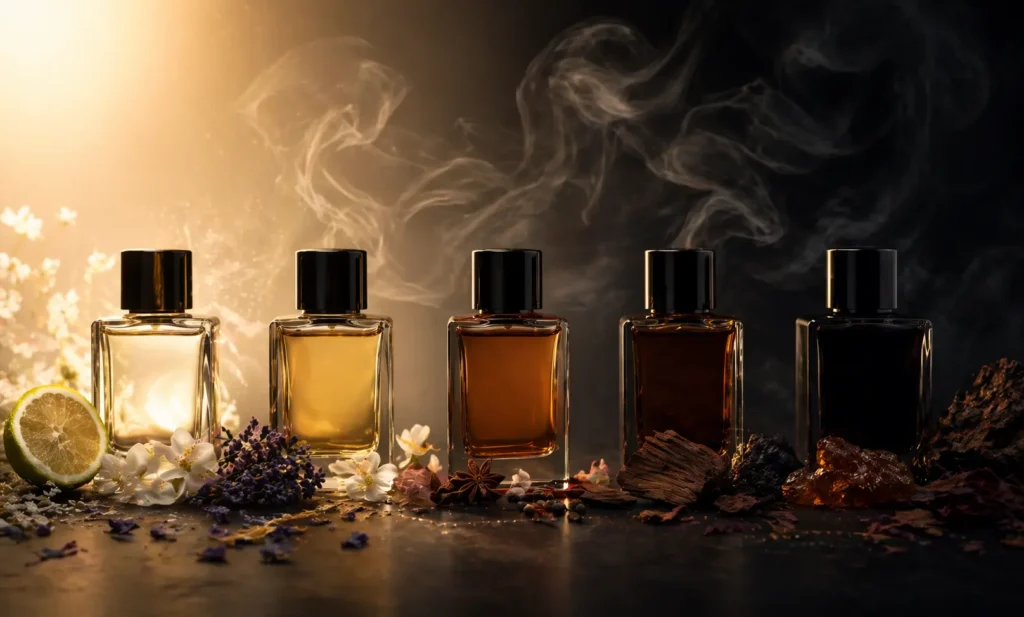
Perfume evolves over time in stages.
According to What Happens to Each Note After You Spray a Perfume?:
- Top notes = light, fresh, volatile
- Heart notes = balanced, expressive
- Base notes = deep, long-lasting
Darkness is usually hidden in the base layer.
That means:
- The perfume may start fresh or bright
- Then gradually become deeper, heavier, darker
This transformation is why some fragrances feel:
- “normal” at first
- but “dark” after 30–60 minutes
🧾 Key Characteristics of Dark-Feeling Perfumes
Here’s a clear breakdown:
| Element | Effect on Perception |
|---|---|
| Heavy base notes (oud, amber, incense) | Creates depth and weight |
| Slow evaporation | Makes the scent feel dense and lingering |
| High complexity | Adds mystery and unpredictability |
| Smoky or resinous accords | Triggers “dark” emotional associations |
| Skin amplification | Can intensify darker facets |
🧠 Why Humans Associate Darkness with Certain Smells
The idea of “darkness” is deeply psychological.
Your brain often links:
- Warm, dense smells → night, shadows, intimacy
- Sharp, fresh smells → daylight, openness, clarity
So when a fragrance:
- lacks brightness
- emphasizes depth and warmth
your mind naturally categorizes it as dark.
❓ FAQ Section
❓ What does “dark perfume” actually mean?
It doesn’t refer to color or ingredients directly. It describes a feeling—usually caused by heavy, deep, or smoky notes combined with slow evaporation and complexity.
❓ Are dark perfumes stronger than light ones?
Not necessarily. They often feel stronger because they are denser and longer-lasting, but projection depends on formulation.
❓ Can the same perfume feel dark on one person but not another?
Yes. Skin chemistry can amplify different notes, making a fragrance feel darker or lighter depending on the wearer.
❓ Do all expensive perfumes feel dark?
No. Some expensive perfumes are bright and airy. However, many luxury fragrances use complex base notes that can create a darker impression.
❓ Why does a perfume become darker over time?
Because base notes emerge later. As lighter notes fade, deeper and heavier components become more noticeable.
🏁 Final Thought
Darkness in perfume isn’t about negativity—it’s about depth, mystery, and evolution.
A dark fragrance doesn’t reveal everything at once.
It unfolds slowly, leaving you with something harder to define… and more difficult to forget.
❓ Have you ever tried a perfume that felt dark to you—what did it remind you of?
Discover more from Perfume Cultures
Subscribe to get the latest posts sent to your email.