
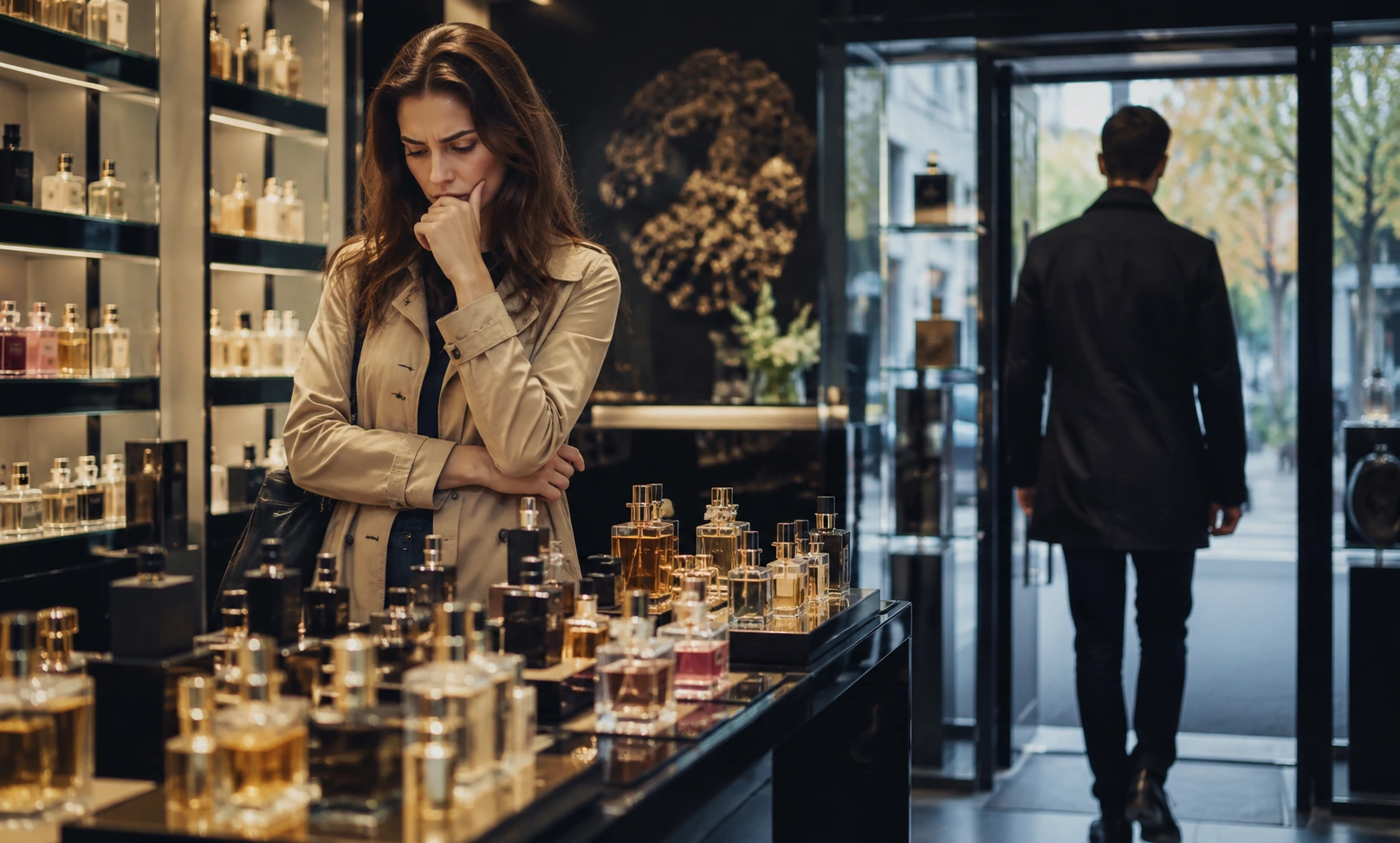
Why Customers Leave Perfume Stores Without Buying Anything
Perfume stores are designed to attract attention, trigger emotion, and encourage exploration. Yet every day across the United States, thousands of customers walk into fragrance stores, test multiple perfumes, spend 15–30 minutes browsing… and leave without buying a single bottle.
Why does this happen?
The answer is often far more psychological than financial.
Modern American consumers rarely make fragrance decisions instantly anymore. Instead, they compare, hesitate, overanalyze, become mentally overloaded, or simply lose emotional connection during the shopping experience itself. In many cases, the store unintentionally creates friction instead of excitement.
And surprisingly, stores with the largest perfume selections are not always the ones making the most sales.
Why do customers leave perfume stores without buying anything?
Customers often leave perfume stores without buying because of decision fatigue, sensory overload, unclear product identity, pricing hesitation, lack of emotional connection, or overwhelming store layouts. Modern shoppers usually prefer guided, simple, and emotionally comfortable shopping experiences instead of being exposed to too many fragrance choices at once.
🧠 Decision Fatigue Is Quietly Destroying Perfume Sales
One of the biggest hidden problems inside modern perfume retail is cognitive overload.
When customers enter a store and immediately face hundreds of bottles, dozens of testers, loud scent clouds, and endless choices, the brain begins to slow down emotionally and mentally.
This is especially true in the American retail environment, where shoppers are already exposed to constant advertising, digital stimulation, and product comparisons all day long.
Instead of excitement, too many perfume choices can create anxiety.
This is exactly why stores with carefully curated selections sometimes outperform stores with massive inventories. In fact, this psychological effect connects directly with the idea explored in Can Offering Too Many Perfumes Harm Your Store Sales? where excessive variety can unintentionally reduce buying confidence.
Many customers initially believe they want unlimited options — but emotionally, they often prefer clarity.
🛍️ The Modern Perfume Shopper Wants Guidance, Not Chaos
Years ago, fragrance shopping was more impulse-driven.
Today, consumers behave differently.
Modern American shoppers frequently arrive with prior research from TikTok, YouTube reviews, Reddit discussions, or Fragrantica-style communities. They already feel overwhelmed before entering the store.
If the physical shopping experience adds even more confusion, hesitation grows rapidly.
Customers now subconsciously look for:
- Simplicity
- Clear product identity
- Comfortable testing experiences
- Emotional reassurance
- Social confidence
- Trustworthy recommendations
When stores fail to provide those emotional anchors, customers delay purchasing decisions.
Sometimes they leave intending to “buy later online,” but many never return.
✨ Luxury Perception Often Depends on Emotional Comfort
Interestingly, customers usually spend more money when they feel emotionally relaxed.
Stores that appear visually calm, spacious, and intentional often create stronger luxury perception than crowded stores packed with products.
This psychological behavior strongly relates to the retail atmosphere discussed in Why Minimalist Perfume Stores Often Feel Premium.
Minimalism reduces mental friction.
When customers can focus on fewer fragrances at a time, they process scent identity more deeply. The experience feels more exclusive, more premium, and more trustworthy.
Overcrowded shelves can unintentionally make even expensive perfumes feel less luxurious.
📈 The Hidden Relationship Between Sampling and Buying Confidence
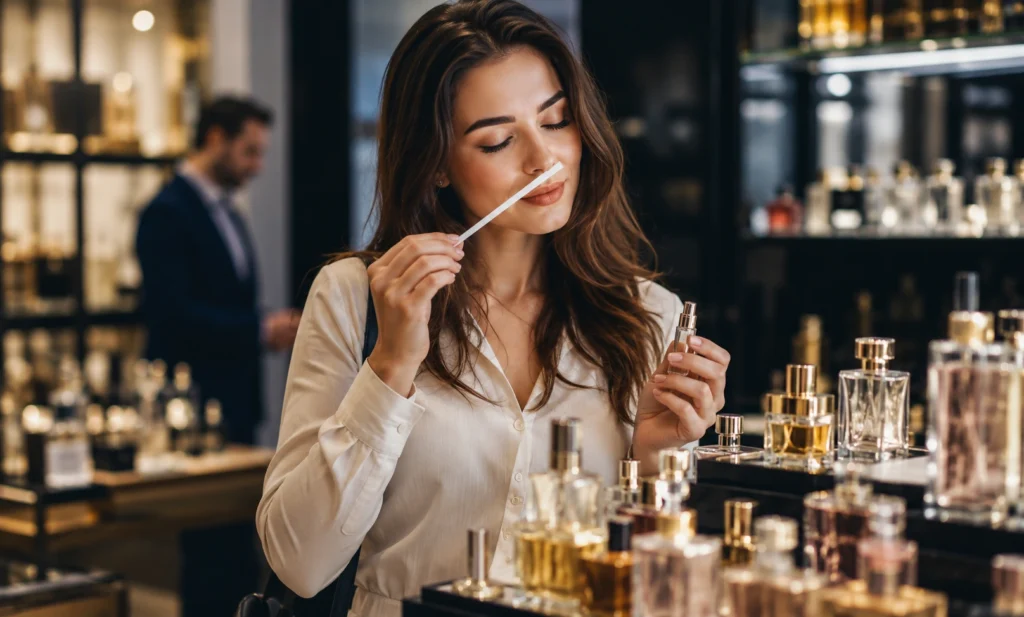
Many customers leave stores simply because they are not emotionally ready to commit immediately after testing.
Fragrance is deeply connected to memory, body chemistry, and mood. Unlike clothing or electronics, perfume decisions often continue psychologically even after leaving the store.
This is why sampling has become extremely important in modern fragrance retail.
The psychology behind this behavior aligns closely with How Fragrance Sampling Changes Buying Decisions, where customers often become more comfortable purchasing after testing fragrances slowly in real-life environments rather than inside overstimulating stores.
A perfume that feels “too strong” in-store may smell amazing outdoors hours later.
Modern consumers know this — which is why many hesitate to buy instantly.
🇺🇸 American Consumers Are Becoming More Emotionally Analytical
American shopping culture has evolved dramatically over the past decade.
Consumers no longer buy fragrances purely because of celebrity marketing or luxury branding. Instead, they increasingly analyze:
- Ingredients
- Longevity
- Social versatility
- Seasonal performance
- Value perception
- Emotional identity
- Uniqueness
This behavioral shift is one reason ingredient transparency now improves trust and engagement inside perfume stores.
As discussed in Why Displaying Perfume Ingredients in Stores Enhances Shopping Experience, consumers often feel safer and more emotionally connected when they understand what they are smelling.
Transparency reduces uncertainty.
And uncertainty is one of the biggest causes of abandoned purchases.
📊 Comparison Table: Why Customers Hesitate Inside Perfume Stores
| Store Experience Problem | Customer Emotional Reaction | Possible Outcome |
|---|---|---|
| Too many perfume options | Mental overload | Leaves without choosing |
| Strong mixed scent environment | Sensory fatigue | Stops testing fragrances |
| Confusing luxury pricing | Purchase hesitation | Delays decision |
| Lack of product explanation | Emotional disconnect | Low trust |
| Crowded store atmosphere | Stress & discomfort | Shorter store visit |
| No sampling flexibility | Fear of regret | “I’ll think about it later” |
| Poor scent storytelling | Weak emotional attachment | No purchase urgency |
🧠 Scent Marketing Can Either Increase Sales — Or Create Pressure
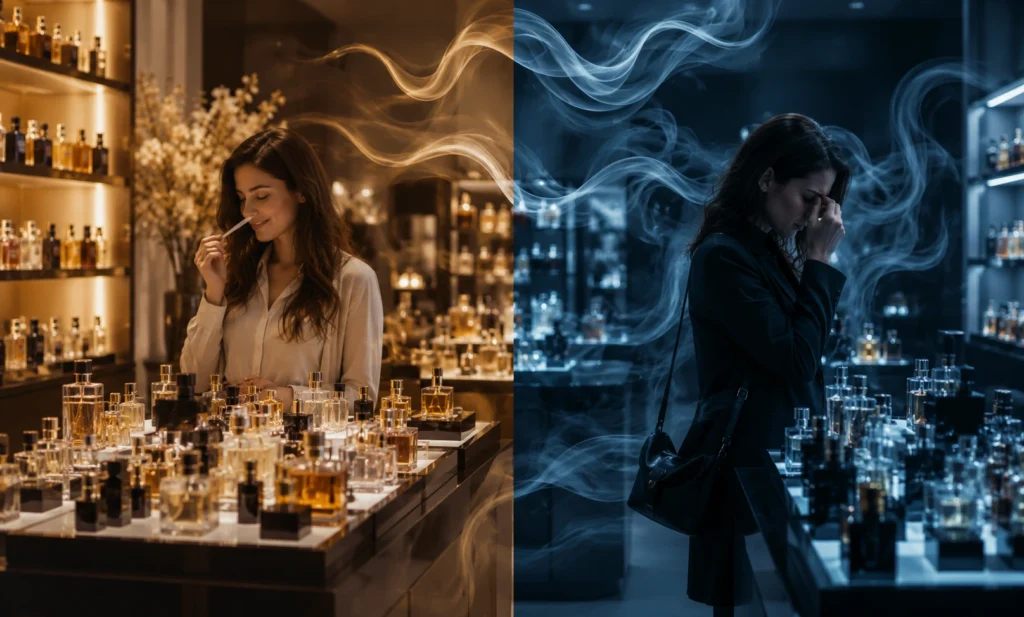
Scent marketing is powerful, but it can backfire when overused.
Some stores diffuse strong ambient fragrances hoping to create emotional immersion. However, excessive scent layering inside the environment can interfere with perfume testing itself.
Customers may struggle to separate the store smell from the fragrances they are sampling.
This becomes psychologically exhausting.
The science behind this behavior relates closely to Why Scent Marketing Works On American Shoppers: The Science Behind It, where emotional scent environments influence mood, memory, and purchasing behavior.
The key difference is balance.
Good scent marketing supports product discovery.
Bad scent marketing competes against it.
What makes perfume stores feel overwhelming?
Perfume stores feel overwhelming when customers experience too many scent options, crowded layouts, excessive ambient fragrance, aggressive sales pressure, or unclear product positioning. These factors create sensory fatigue and decision paralysis, reducing purchase confidence.
💰 Price Isn’t Always the Real Problem
Many retailers assume customers leave because perfumes are expensive.
But in reality, hesitation often comes from uncertainty rather than price alone.
Modern consumers are surprisingly willing to spend money when they emotionally justify the purchase.
This psychological pattern also appears in How American Consumers Balance Luxury and Affordability in Perfume Buying, where shoppers frequently seek emotional value rather than simply the lowest price.
Customers ask themselves questions like:
- “Will I actually wear this often?”
- “Does this feel unique enough?”
- “Will people compliment this scent?”
- “Is this fragrance worth the emotional investment?”
When stores fail to answer those emotional questions, the buying decision weakens.
🛍️ The Most Successful Perfume Stores Reduce Psychological Friction
The highest-converting perfume stores usually share several hidden characteristics:
✔️ Cleaner layouts
✔️ Guided fragrance discovery
✔️ Controlled scent environments
✔️ Emotional storytelling
✔️ Selective product curation
✔️ Sampling flexibility
✔️ Less aggressive selling pressure
Modern fragrance retail is no longer just about displaying products.
It is about reducing hesitation.
The easier a store makes emotional decision-making feel, the more likely customers are to buy confidently.
🔎 Why This Trend May Become Even Stronger in the Future
As online fragrance communities continue growing, consumers are becoming more informed and more psychologically selective.
Many shoppers now enter stores primarily to confirm feelings they already developed online.
That means physical stores must evolve from simple product display spaces into emotionally intelligent environments.
The stores that understand customer psychology — not just perfume inventory — will likely dominate the next generation of fragrance retail.
❓FAQ
Why do people test perfumes but not buy them?
Many customers test perfumes for exploration, comparison, or entertainment without immediate purchase intent. Others become overwhelmed by too many scent options or prefer testing fragrances later at home before committing.
Does having too many perfumes reduce store sales?
Yes, in some cases. Excessive choice can create decision fatigue, making customers less confident about purchasing.
Why do minimalist perfume stores often feel more luxurious?
Minimalist stores reduce visual and sensory overload, helping customers focus emotionally on individual fragrances. This often creates a stronger premium perception.
Why is fragrance shopping emotionally difficult?
Perfume is deeply connected to identity, memory, and social confidence. Customers often fear making the “wrong” scent decision, especially with expensive fragrances.
Do customers trust perfume stores more when ingredients are visible?
Often yes. Ingredient transparency can increase emotional trust and help customers feel more informed and comfortable during the shopping experience.
🧠 Final Thoughts
Customers rarely leave perfume stores without buying because they dislike fragrance.
More often, they leave because the experience itself created uncertainty.
Modern consumers want perfume shopping to feel emotionally comfortable, psychologically clear, and personally meaningful.
And in today’s American retail landscape, the stores that simplify emotional decision-making may ultimately outperform the stores with the biggest inventories.
What do you personally think makes perfume shopping overwhelming — too many choices, strong smells, high prices, or something else entirely?
Discover more from Perfume Cultures
Subscribe to get the latest posts sent to your email.




4 Comments