
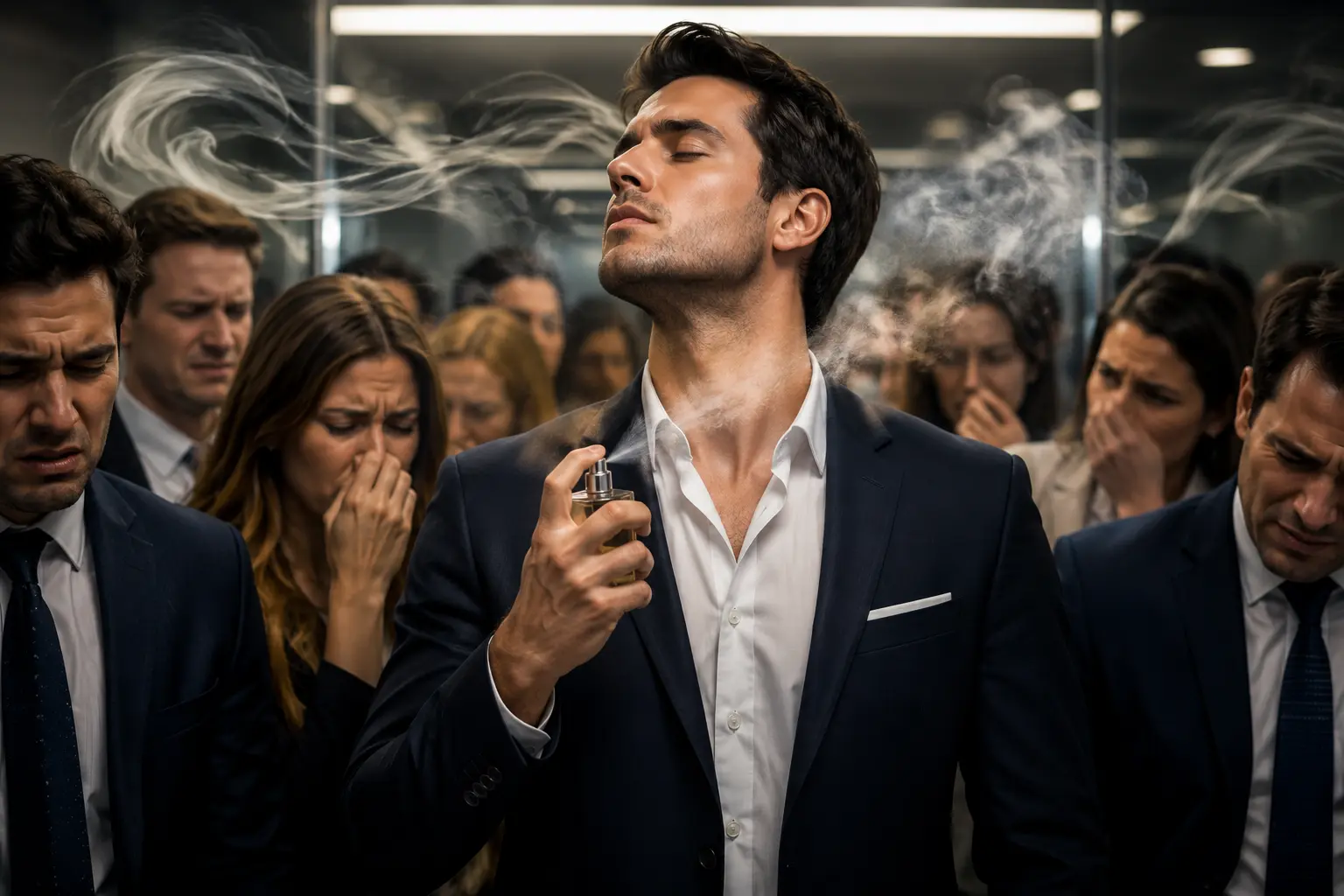
How Do You Tell If a Perfume Is Too Noticeable?
Perfume is supposed to create presence — not pressure.
But one of the hardest things about fragrance is that most people cannot accurately smell their own projection after wearing a scent for a while. What feels “normal” to you may feel overpowering to everyone around you.
That is where fragrance awareness becomes important.
A perfume that is too noticeable does not always smell bad. In fact, some of the most luxurious and expensive fragrances in the world can still become socially exhausting when they project too loudly, fill enclosed spaces, or linger too aggressively in the air.
The real question is not:
“Does the perfume smell good?”
The real question is:
“How much of it are other people experiencing?”
How do you know if your perfume is too noticeable?
Your perfume may be too noticeable if:
- people smell you before they see you,
- your scent fills rooms quickly,
- others step back during conversations,
- the fragrance remains strong for hours in enclosed spaces,
- or you frequently receive comments about your scent intensity rather than the scent itself.
Strong projection is not always a problem, but excessive presence can create discomfort in professional, social, or public environments.
Why Most People Misjudge Their Own Perfume Strength
One of the biggest reasons people wear too much fragrance is something called olfactory adaptation.
Your brain slowly “filters out” smells that remain around you continuously. This means your perfume starts feeling weaker to you long before it becomes weaker to others.
So while you may think:
“My fragrance disappeared.”
Other people may still smell it very clearly from several feet away.
This is also why many fragrance enthusiasts accidentally overspray.
If you want to understand the signs that your scent may already be dominating the environment around you, read our article on How Do You Know If Your Perfume Is Filling The Room?
The Difference Between “Noticeable” and “Pleasant”
A perfume becoming noticeable is not automatically bad.
In fact:
- attraction,
- memory,
- emotional association,
- and personal identity
are all strongly connected to scent.
The issue begins when:
- the perfume interrupts conversations,
- dominates shared spaces,
- creates physical discomfort,
- or becomes impossible to ignore.
There is a major psychological difference between:
- “That person smells amazing.”
and: - “That perfume is overwhelming.”
The second reaction often happens when projection becomes stronger than social context allows.
Some Perfumes Are Designed to Be Loud

Not all fragrances are built the same way.
Certain perfume styles naturally project more aggressively because of:
- heavier base materials,
- stronger synthetic molecules,
- dense resinous accords,
- amber woods,
- musks,
- oud,
- patchouli,
- or modern aroma chemicals designed for extreme longevity.
This is where understanding sillage becomes important.
If you want to understand why some fragrances remain noticeable for an entire day even with small sprays, explore The Science Behind Sillage: Why Some Perfumes Stay Noticeable All Day.
Social Signs Your Perfume May Be Too Strong
Most people will never directly tell you your fragrance is overpowering.
Instead, they communicate it indirectly.
Common Signs Include:
| Social Behavior | What It May Mean |
|---|---|
| People lean away slightly | Projection may feel intrusive |
| Someone opens a window | Air feels heavy with fragrance |
| Comments focus on “strength” instead of smell | The scent is dominating attention |
| Your perfume enters rooms before you do | Overspraying or extreme projection |
| You still smell strong after many hours indoors | The scent cloud is lingering heavily |
| People become quieter or shorter in conversation | Fragrance may be causing subtle discomfort |
These reactions are often subconscious rather than intentional.
Why Good Perfumes Can Still Create Negative Reactions
A fascinating truth about fragrance psychology is this:
A perfume can smell objectively beautiful and still create negative emotional reactions.
Why?
Because humans react to:
- intensity,
- proximity,
- context,
- memory,
- sensory fatigue,
- and environmental pressure.
This explains why even luxury perfumes sometimes trigger irritation in offices, elevators, classrooms, clinics, or public transportation.
We explore this deeper in Why People React Negatively to Your Perfume (Even If It Smells Good).
Why do people react negatively to strong perfume?
People often react negatively to strong perfume because scent directly affects the brain’s sensory and emotional systems. Overly noticeable fragrances can create mental fatigue, headaches, sensory overload, or discomfort in enclosed spaces — even when the perfume itself smells pleasant.
The Psychology of “Soft” Fragrances
One of the biggest misconceptions in fragrance culture is that stronger always means better.
In reality, softer fragrances often create:
- more comfort,
- more intimacy,
- more trust,
- and more social flexibility.
A subtle fragrance allows people to discover the scent naturally instead of being forced into it.
This creates a completely different emotional experience.
That is one reason many people perceive soft fragrances as:
- cleaner,
- more elegant,
- more intelligent,
- and sometimes even more attractive.
This psychological effect is explored beautifully in Does a Soft Perfume Create a Stronger Impression Than a Loud One?
Why Subtle Perfumes Often Feel More Likeable

Human scent perception is deeply connected to safety and comfort.
When a perfume stays close to the skin:
- it feels personal,
- controlled,
- and socially respectful.
But when a fragrance expands aggressively into shared airspace, people may unconsciously interpret it as:
- attention-seeking,
- invasive,
- exhausting,
- or socially unaware.
This is one reason soft fragrances frequently perform better in:
- workplaces,
- universities,
- hospitals,
- dates,
- airplanes,
- and social gatherings.
If you want to understand the psychology behind this effect, read Can a Subtle Perfume Make You More Likeable? The Psychology Behind Soft Fragrances.
Context Matters More Than Strength
The same perfume can feel:
- luxurious in winter,
- unbearable in summer,
- elegant outdoors,
- but overwhelming inside an elevator.
This is why fragrance awareness matters more than projection alone.
A scent that works beautifully at:
- a nightclub,
- outdoor dinner,
- or evening event
may become socially exhausting in:
- meetings,
- clinics,
- classrooms,
- waiting rooms,
- or flights.
The smartest fragrance wearers do not simply ask:
“How strong is this perfume?”
They ask:
“Is this environment appropriate for this level of projection?”
Perfume Around Sensitive People
Some individuals are significantly more sensitive to airborne fragrance particles than others.
For them, strong perfume may trigger:
- headaches,
- nausea,
- dizziness,
- breathing discomfort,
- sensory fatigue,
- or allergic reactions.
This is especially important in:
- healthcare environments,
- public transport,
- offices,
- and enclosed social spaces.
If you regularly wear fragrance around sensitive individuals, check out What Perfume Should You Wear Around People With Allergies?
The “Invisible Radius” Rule
One of the best fragrance principles is this:
Your perfume should mostly exist inside your personal space — not dominate everyone else’s.
A balanced fragrance experience usually means:
- people notice your scent during close interaction,
- not from across the room.
This creates:
- mystery,
- elegance,
- intimacy,
- and sophistication.
Ironically, perfumes that stay slightly closer to the skin often become more memorable because they feel discovered rather than announced.
Final Thoughts
A perfume becomes “too noticeable” when it stops enhancing your presence and starts controlling the environment around you.
The goal of fragrance is not to overwhelm people.
It is to create atmosphere, memory, emotion, and identity in a balanced way.
The most sophisticated fragrance wearers are usually not the loudest ones.
They are the people who understand:
- timing,
- environment,
- projection,
- psychology,
- and social comfort.
Sometimes the most powerful scent in the room is the one people lean closer to notice — not the one they are trying to escape from.
❓FAQ
How many sprays make a perfume too noticeable?
It depends on the fragrance concentration, projection strength, weather, and environment. Strong perfumes may become overwhelming with only 2–3 sprays, especially indoors.
Is strong projection always a bad thing?
No. Strong projection can work well in outdoor events, nightlife, or cold weather. The problem appears when the fragrance becomes socially exhausting or inappropriate for the setting.
Why can’t I smell my own perfume after a while?
This happens because of olfactory adaptation. Your brain gradually filters familiar smells, making your fragrance seem weaker to you even when others still smell it strongly.
Are subtle perfumes more attractive?
In many social situations, yes. Subtle fragrances often feel cleaner, more elegant, and more approachable because they respect personal space.
Can strong perfume cause headaches for others?
Yes. Some people are highly sensitive to fragrance molecules, especially in enclosed spaces. Strong projection can trigger headaches, nausea, or sensory discomfort.
Should perfume be noticeable from across the room?
Usually no. Most fragrance etiquette experts believe perfume should mainly be noticeable during closer interaction rather than dominating entire rooms.
💬 Interactive Question
Have you ever realized afterward that your perfume was much stronger than you thought — or experienced someone else wearing a fragrance that completely dominated the room?
Discover more from Perfume Cultures
Subscribe to get the latest posts sent to your email.






4 Comments