What Perfume Should You Wear Around People With Allergies?
Choosing the right perfume isn’t just about smelling good—it’s about how your scent affects the people around you. For individuals with fragrance sensitivities or allergies, even a small amount of the wrong perfume can trigger headaches, irritation, or discomfort.
This guide explains what perfumes to wear (and avoid) around sensitive individuals—based on science, social awareness, and real-world behavior.
What perfume should you wear around people with allergies?
Wear light, low-projection perfumes with minimal synthetic ingredients. Choose fragrances labeled “skin scent,” “clean,” or “hypoallergenic,” and apply them sparingly to avoid overwhelming others.
🚫 Why Some Perfumes Trigger Allergies
Perfume sensitivity isn’t always a true allergy—it’s often a sensory or chemical reaction. Common triggers include:
- Strong synthetic musks
- Heavy florals (like white flowers)
- High alcohol concentration
- Dense oriental or spicy accords
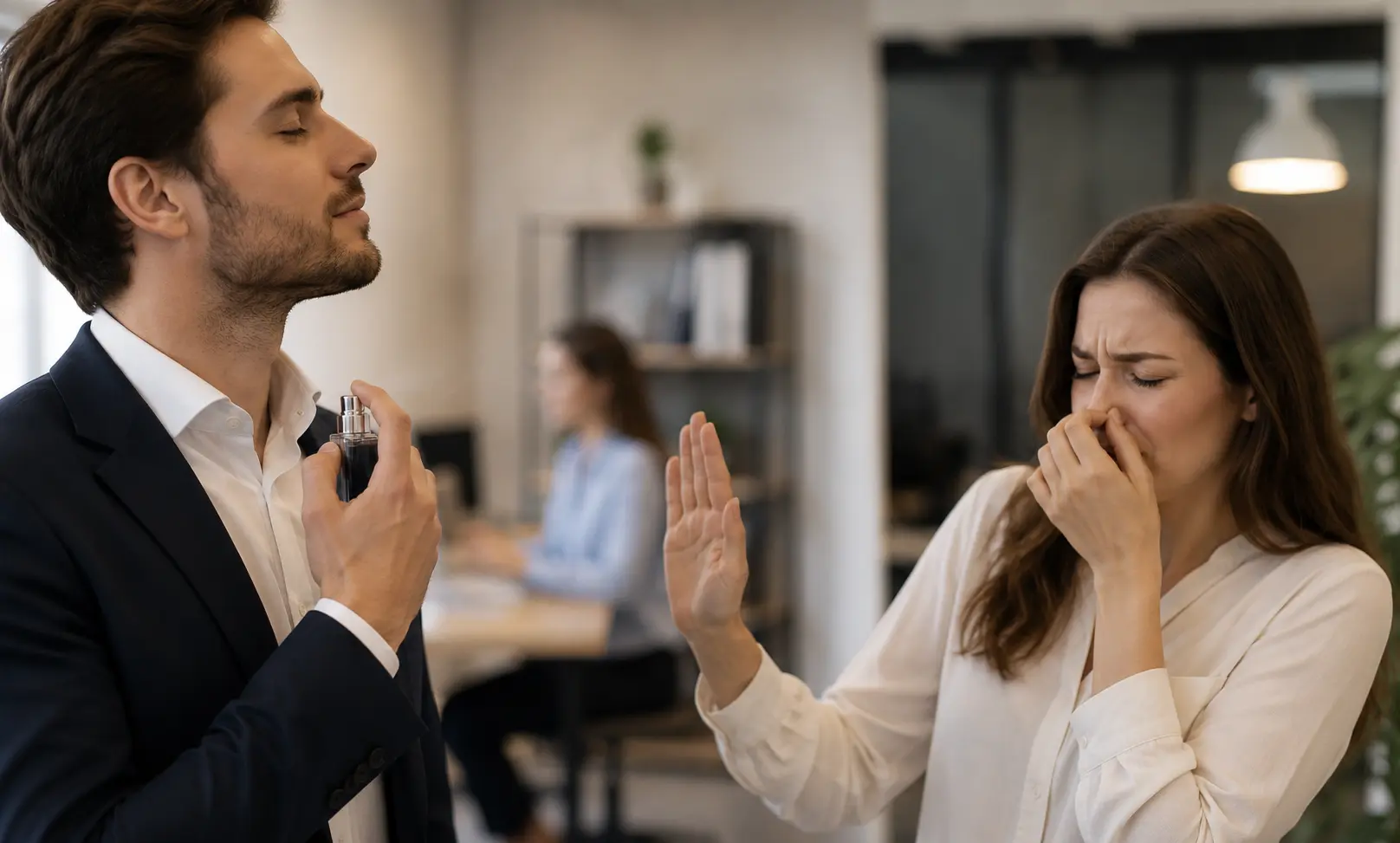
Interestingly, people may not always express discomfort directly. In some cases, reactions appear subtly through body language or avoidance behavior—something explored in Why Do Some People React Negatively to Your Perfume Without Saying Anything?
🌿 What Type of Perfume Is Safest?
When around people with sensitivities, your goal is simple:
👉 Stay close to the skin and avoid diffusion
✔️ Safe fragrance profiles:
- Skin scents (soft musk, light amber)
- Fresh and airy notes (green tea, cucumber)
- Minimalist compositions (2–5 notes max)
❌ Risky fragrance profiles:
- Heavy oud, incense, or leather
- Sweet gourmands with strong projection
- Overly complex niche perfumes
What type of fragrance is best for sensitive environments?
The best choice is a low-sillage, skin-close fragrance that doesn’t project into the air. These scents remain personal and reduce the chance of triggering reactions in others.
📊 Comparison Table: Safe vs Risky Perfumes Around Allergies
| Factor | Safe Perfumes | Risky Perfumes |
|---|---|---|
| Projection (Sillage) | Very low (skin-level) | High (fills the room) |
| Composition | Minimal, simple | Complex, layered |
| Notes | Fresh, clean, soft musk | Oud, spice, heavy florals |
| Alcohol Presence | Moderate to low | High |
| Social Impact | Subtle, non-intrusive | Noticeable, potentially irritating |
🧳 Context Matters More Than You Think

Even a “safe” perfume can become problematic depending on the environment.
Closed spaces—like offices or elevators—trap scent molecules and intensify exposure. This is why choosing the right fragrance in confined areas is critical, as discussed in What Perfume Should You Avoid in Elevators?
👃 It’s Not Just the Perfume—It’s the Intensity
Many people assume they’re wearing a “light” fragrance, but in reality, it may be more noticeable than they think.
Learning how to evaluate your scent’s presence is key. If your fragrance is easily detectable from a distance, it may already be too strong—something explained in How Do You Tell If Your Perfume Is Too Noticeable?
🌫️ When Perfume Fills the Space, It Becomes a Problem
A major issue for sensitive individuals is airborne exposure.
If your scent lingers in a room after you leave, it’s no longer a personal fragrance—it’s an environmental factor. This spatial effect is explored in How Do You Know If Your Perfume Is Filling the Room?
🎯 The Smart Strategy: Choose “Soft Power” Over Loudness
There’s a misconception that stronger perfumes create better impressions. In reality, subtle scents often feel more refined and socially aware—especially in sensitive environments.
This concept aligns with the idea that softer fragrances can leave a more positive impact, as discussed in Does a “Soft” Perfume Create a Stronger Impression Than a Loud One?
🧠 How to Apply Perfume Around Sensitive People
✔️ 1 spray maximum
✔️ Apply under clothing (chest area)
✔️ Avoid pulse points that radiate heat (neck, wrists)
✔️ Skip reapplication in shared spaces
👉 The goal: you can smell it, others can’t
❓ FAQ: Perfume and Allergies
❓ Can perfume really cause allergic reactions?
Yes. Some people experience headaches, respiratory irritation, or skin sensitivity due to certain fragrance ingredients.
❓ Are natural perfumes safer?
Not always. Natural ingredients like essential oils can still trigger reactions in sensitive individuals.
❓ How far should someone be able to smell your perfume?
Ideally, only within very close personal distance (less than an arm’s length).
❓ Is it better to skip perfume completely?
In highly sensitive environments (like hospitals or airplanes), yes—going fragrance-free is often the safest choice.
❓ What’s the safest way to test if your perfume is too strong?
Apply once, leave the room, then return after a few minutes. If you still smell it clearly, it may be too strong.
💬 Final Thought
If someone stood next to you in a quiet room…
would your fragrance feel like a gentle presence—or an unavoidable cloud?
Discover more from Perfume Cultures
Subscribe to get the latest posts sent to your email.





One Comment