How Can You Test Your Perfume Without Wearing It All Day? Smart Fragrance Testing Tricks
Buying or testing a fragrance used to require patience. Spray it on your skin, wait six hours, and hope the dry down still feels right by the evening.
But modern fragrance wearers are becoming more strategic.
Most people today don’t want to sacrifice an entire day just to discover that a perfume becomes too sweet, too loud, too metallic, or simply disappears after 90 minutes. The good news? You can learn a surprising amount about a fragrance in less than 30 minutes — if you know what to look for.
The real secret is understanding behavior patterns inside perfume rather than waiting for the full lifecycle every single time.
And interestingly, many experienced fragrance collectors rarely “full-day test” every scent anymore.
Can you test a perfume without wearing it all day?
Yes. You can evaluate a perfume quickly by analyzing its opening structure, projection behavior, evaporation speed, skin interaction, and scent trail changes during the first 15–45 minutes. These early stages often reveal whether a fragrance will become overpowering, weak, overly synthetic, or well-balanced later in the day.
🧠 Why Full-Day Testing Is Sometimes Overrated
People often assume the “dry down” is the only thing that matters.
But in reality, your brain usually decides whether you like a fragrance extremely early.
Within the first 10–20 minutes, your senses already begin detecting:
- texture smoothness
- synthetic sharpness
- projection intensity
- sweetness density
- freshness realism
- skin compatibility
- emotional comfort
This doesn’t mean long testing is useless.
It means many fragrance problems reveal themselves much earlier than people realize.
For example:
- Harsh ambroxan often becomes obvious quickly
- Overly loud projection is noticeable early
- Cheap sweetness appears almost immediately
- Poor blending usually exposes itself within minutes
That’s why experienced testers often rely on “micro-testing behavior.”
🔬 The 30-Minute Fragrance Behavior Method
Instead of waiting all day, divide your testing into phases.
| Time Window | What You Should Observe | What It Usually Reveals |
|---|---|---|
| First 60 seconds | Alcohol blast & sharpness | Quality of opening |
| 5 minutes | Projection intensity | Whether it may become overwhelming |
| 15 minutes | Texture smoothness | Balance vs harshness |
| 30 minutes | Skin integration | Whether it feels natural or forced |
| 45 minutes | Scent fatigue effect | If your nose adapts too fast |
This method helps you predict performance patterns surprisingly accurately.
👃 Smell Your Skin From Different Distances
One major mistake people make:
They only smell perfume directly from the wrist.
That tells you almost nothing about real-world perception.
Instead:
- smell from very close
- smell from arm’s length
- walk away and return
- move your arm naturally through the air
Perfume behaves differently in motion.
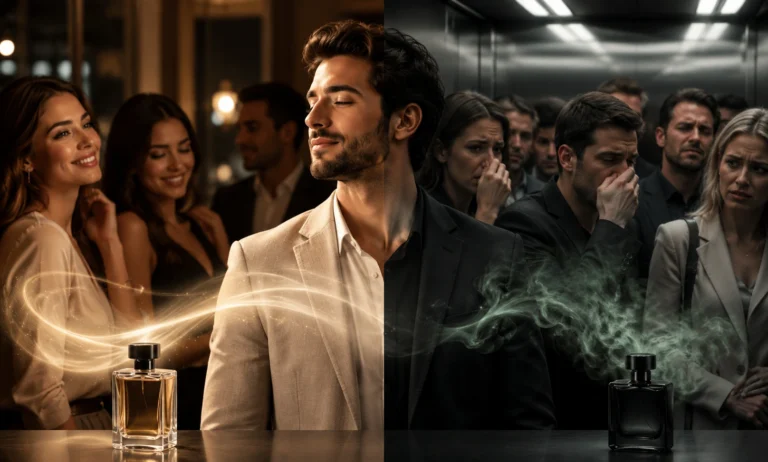
This is one reason why some fragrances seem invisible to you but suddenly become noticeable to others later. The scent cloud moves differently than direct skin scent.
That same phenomenon is explored more deeply in Why Do Some People Notice Your Perfume Only After You Leave?, especially regarding lingering scent trails and delayed perception effects.
What is the fastest way to test a perfume accurately?
The fastest accurate perfume test is applying 1–2 sprays on skin, waiting 15–30 minutes, then checking projection, scent texture, and skin interaction from different distances and while moving. This reveals more realistic performance than repeatedly smelling the wrist up close.
🚶 Movement Reveals More Than Sitting Still
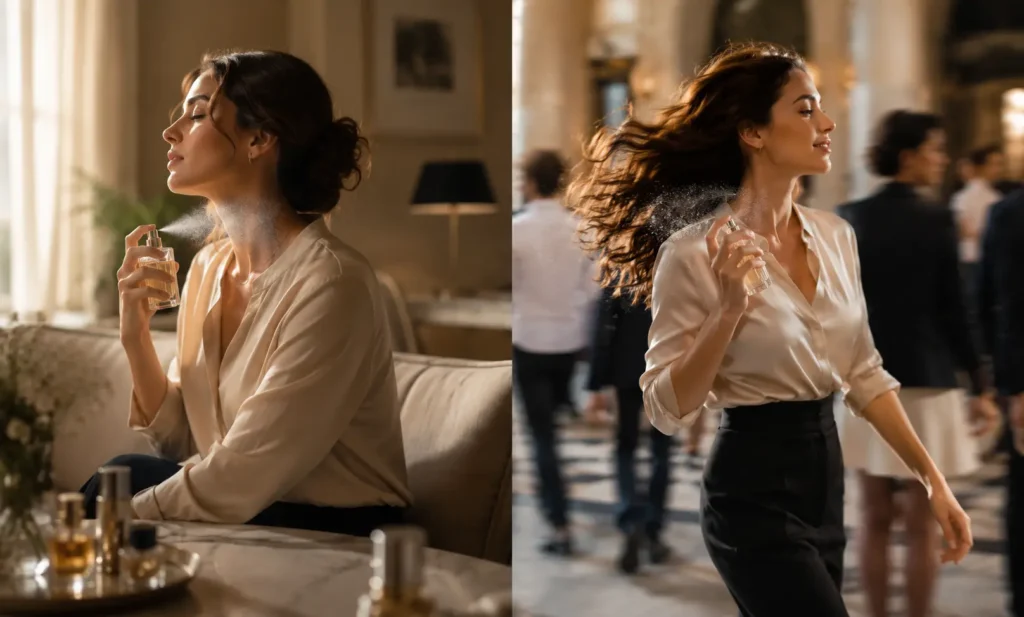
A perfume tested while sitting quietly behaves differently from one tested while walking.
Body heat, air circulation, sweat level, and motion all affect projection.
This is why some fragrances feel soft indoors but suddenly become aggressive outside.
Try this:
- Spray once on the wrist
- Walk for 3–5 minutes
- Return indoors
- Smell the scent cloud around you
You’ll often notice details you completely missed earlier.
This is especially important if you worry about whether your fragrance is projecting too far into a room. In fact, How Do You Know If Your Perfume Is Filling The Room? explains how movement and air flow dramatically change fragrance perception.
⚖️ Loud Perfume vs Balanced Perfume
Testing quickly is also about identifying personality type.
Some fragrances immediately announce themselves aggressively.
Others slowly build subtle presence.
And interestingly, softer fragrances often create a more refined impression because they encourage people to move closer instead of attacking the room instantly.
That’s one reason subtle compositions are becoming more respected in modern fragrance culture. The psychology behind this is explored further in Does a Soft Perfume Create a Stronger Impression Than a Loud One?
🚨 Watch For “Mental Fatigue” Early
Sometimes a perfume technically smells good…
…but your brain gets tired of it fast.
This is one of the strongest warning signs during quick testing.
If after 20 minutes you already feel:
- mentally exhausted
- irritated
- overwhelmed
- nose-blind
- pressured by the scent cloud
…the fragrance may become unbearable during a full day.
Many overly strong fragrances create what people mistake for “power,” when in reality they create sensory fatigue.
This is closely related to the warning signs discussed in How Do You Tell If a Perfume Is Too Noticeable?
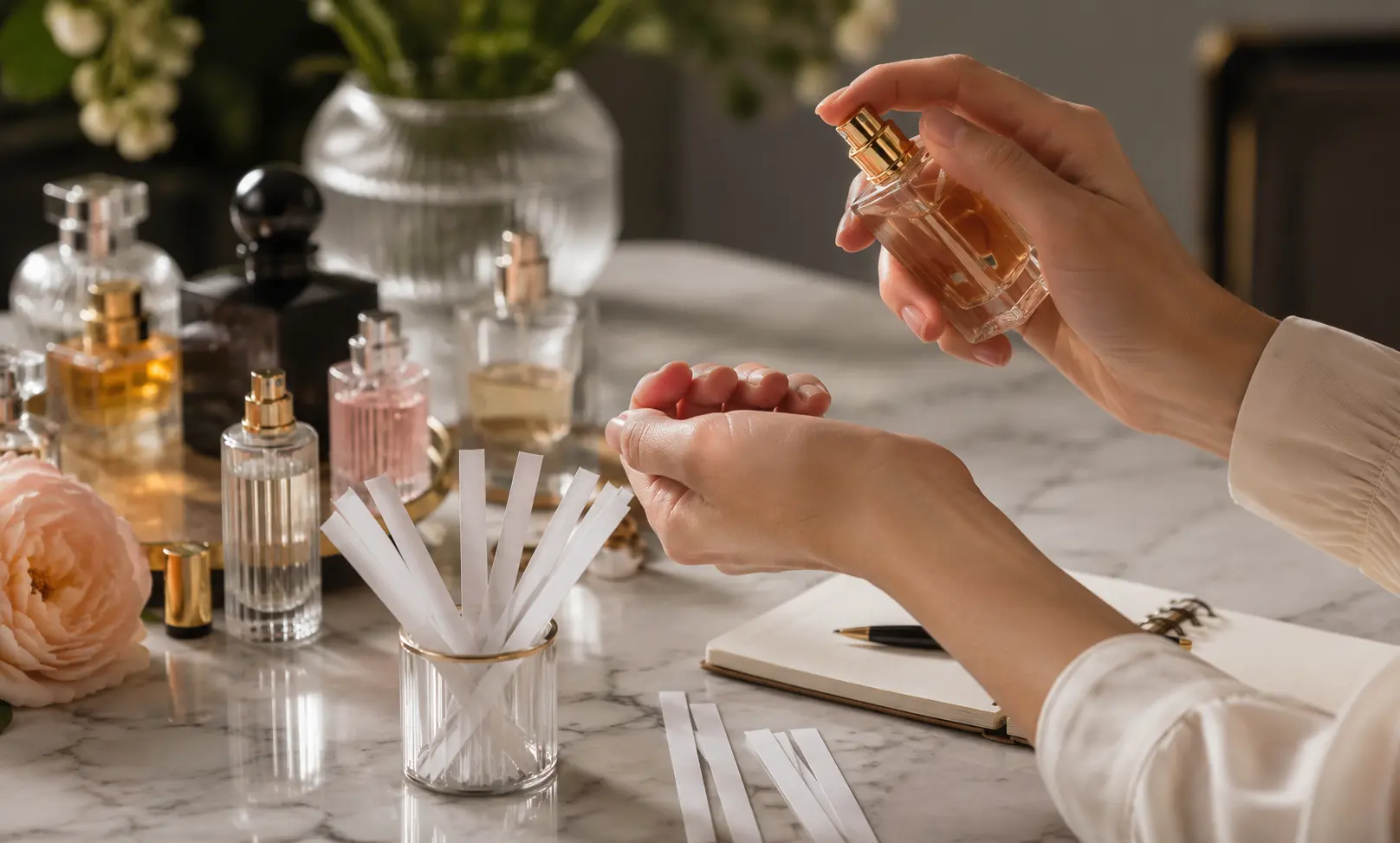
🧪 Paper Strip vs Skin: Which Is Better?
| Testing Method | Strengths | Weaknesses |
|---|---|---|
| Paper strip | Reveals opening clearly | Cannot show skin chemistry |
| Skin testing | Shows real performance | Influenced by body chemistry |
| Clothing testing | Reveals longevity | Distorts development |
| Air testing | Shows projection style | Harder to analyze details |
Professional testers often combine all four.
Not because they are obsessive…
…but because each method reveals a different side of perfume behavior.
🕒 Don’t Rush Reapplication During Testing
A common mistake during fragrance testing:
People keep spraying more because they think the scent disappeared.
In reality, the nose adapts very quickly.
Reapplying too early destroys your ability to judge projection accurately.
Instead:
- wait calmly
- leave the room briefly
- return later
- test from distance again
This gives your senses time to reset naturally.
If you struggle with this problem often, How Long Should You Wait Before Reapplying Perfume? explains why over-spraying usually creates false performance judgments.
🧭 The Hidden Trick Professionals Use
Many experienced fragrance enthusiasts don’t ask:
“Do I like this perfume?”
Instead, they ask:
“How does this perfume behave?”
That single shift changes everything.
Because fragrance quality is often less about the smell itself…
…and more about:
- how it moves
- how it projects
- how smoothly it evolves
- how naturally it blends into human presence
A perfume can smell amazing on paper yet feel socially exhausting in real environments.
❓FAQ
How long should you test a perfume before deciding?
Usually 30–60 minutes is enough to understand a perfume’s core behavior, projection style, and skin interaction. Full-day testing becomes more important for expensive purchases or highly complex fragrances.
Why does perfume smell different after 20 minutes?
As alcohol evaporates, deeper ingredients begin appearing. Heat, skin oils, and air movement also change how notes are perceived over time.
Can you trust perfume test strips?
Partially. Test strips reveal opening quality and note structure well, but they cannot replicate skin chemistry, warmth, or realistic projection.
Why do perfumes disappear quickly during testing?
Often because of olfactory fatigue rather than poor longevity. Your brain adapts to repeated exposure faster than most people realize.
Is one spray enough for testing?
Yes. One or two sprays usually reveal enough information about projection, smoothness, and scent behavior without overwhelming your senses.
Final Thoughts
The biggest mistake in fragrance testing is assuming you must wear a perfume for an entire day to understand it.
Sometimes the most important clues appear within minutes.
Perfume reveals its personality early — through texture, movement, projection, balance, and the emotional reaction it creates around you.
The real skill is learning how to observe those signals intelligently instead of simply waiting longer.
So next time you test a fragrance, ask yourself:
Are you evaluating how the perfume smells… or how the perfume behaves around human life?
Discover more from Perfume Cultures
Subscribe to get the latest posts sent to your email.