🧠 Why Scent Fades But Comes Back (And What’s Really Happening)
Have you ever sprayed a perfume, noticed it disappear… then suddenly smelled it again hours later?
It feels almost mysterious — like the scent vanished and then “came back to life.”
But in reality, nothing supernatural is happening. This experience is a combination of chemistry, physics, and how your brain processes smell.
Let’s break it down step by step.
🧪 Why Perfume Seems to Fade So Quickly
When you first spray a fragrance, you’re mostly smelling the top notes — the lightest, most volatile molecules.
These molecules:
- Evaporate quickly
- Travel fast through the air
- Hit your nose intensely at first
That’s why the scent feels strong… then suddenly disappears.
This process is part of how fragrance molecules behave, which is explained in detail in How Perfume Works: The Science Behind Fragrance, Molecules, and Human Smell.
✔️ Key insight:
The scent didn’t fully disappear — only the fastest molecules did.
👃 Your Nose “Turns Off” (Olfactory Fatigue)
One of the biggest reasons scent seems to vanish is not the perfume — it’s your brain.
Your olfactory system adapts quickly:
- It reduces sensitivity to continuous smells
- It filters out familiar signals to focus on new ones
This is called olfactory adaptation (or sensory fatigue).
So what happens?
- You stop noticing the scent
- Others can still smell it
- Then suddenly… you detect it again
This explains why your perception changes over time, similar to what’s discussed in Why Your First Impression Of a Perfume Is Often Wrong.
✔️ Key insight:
The scent didn’t come back — your brain started paying attention again.
🔄 The Evolution of Notes (Why the Smell Changes)
Perfumes are not static. They evolve through layers:
- Top notes → fade quickly
- Heart notes → emerge next
- Base notes → last the longest
So when you think the scent “came back,” you’re actually smelling a different phase of the fragrance.
This transformation is explained further in What Happens to Each Note After You Spray a Perfume?.
✔️ Key insight:
You’re not smelling the same scent again —
you’re experiencing a new layer of it.
🧬 Skin Chemistry Changes Everything
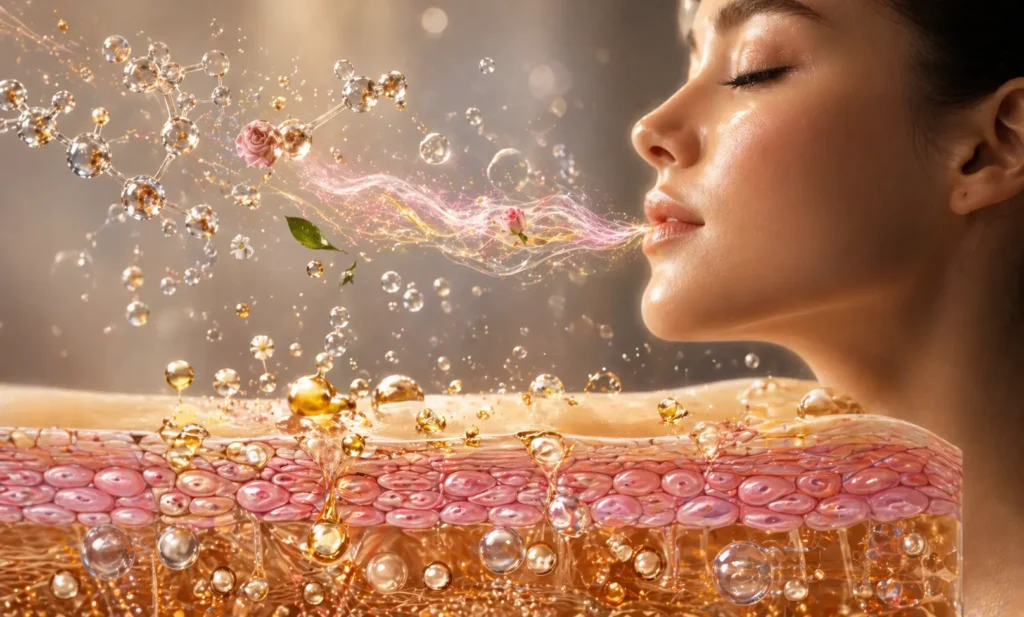
Perfume interacts with your skin’s:
- Oils
- pH level
- Temperature
This interaction can:
- Slow down evaporation
- Reactivate certain molecules
- Release scent in waves
That’s why the fragrance may feel like it disappeared and returned differently.
This behavior connects closely to the concept explained in Why Does Perfume Smell Different on Skin?.
✔️ Key insight:
Your skin acts like a dynamic surface, not a passive one.
🌬️ Air Movement and “Scent Waves”
Sometimes the scent truly becomes noticeable again due to the environment.
Factors like:
- Movement
- Heat
- Airflow
can push lingering molecules back toward your nose.
This creates what feels like a “return” of the fragrance — especially with perfumes that have strong projection.
This ties into the concept of longevity and diffusion explained in How Long Does Perfume Last? Understanding Longevity.
✔️ Key insight:
The scent was always there —
you just moved back into its invisible trail.
🧠 The Psychological Effect (Why It Feels Sudden)
Your brain is constantly filtering sensory input.
So when:
- You change focus
- You move
- Or the scent contrasts with a new environment
…it suddenly becomes noticeable again.
This creates the illusion of:
“The scent disappeared… and then came back.”
But in reality:
- It faded
- You adapted
- Then perception reset
⚖️ Why Some Perfumes “Come Back” More Than Others
Not all fragrances behave the same way.
Perfumes that tend to “fade and return” usually have:
- Strong base notes (woods, resins, musk)
- Complex structures
- Moderate to high projection
Simpler fragrances often:
- Fade more linearly
- Don’t create this illusion as strongly
✔️ Key insight:
The more layered the fragrance, the more “alive” it feels over time.
❓ FAQ — Common Questions About Scent Fading and Returning
❓ Does perfume actually come back after fading?
No. The scent doesn’t disappear and reappear. What changes is your perception and the fragrance’s evolution.
❓ Why can others smell my perfume when I can’t?
Because your nose adapts quickly. This is called olfactory fatigue, and it makes you temporarily “blind” to the scent.
❓ Why does the scent smell different when it comes back?
Because you’re now smelling heart or base notes, not the original top notes.
❓ Does skin type affect this effect?
Yes. Oily or warm skin can release scent more gradually, making it feel like the fragrance returns.
❓ Can movement or heat bring the scent back?
Yes. Airflow and body movement can push lingering molecules back into your smell zone.
🧭 Final Insight
What feels like a disappearing and returning scent is actually a combination of:
- 🧪 Molecular evaporation
- 👃 Olfactory adaptation
- 🔄 Fragrance evolution
- 🌬️ Environmental movement
Once you understand this, perfume stops being predictable…
and starts feeling like a living experience that unfolds over time.
💬 Have you ever noticed a fragrance “coming back” hours later — and did it smell the same or completely different?
Discover more from Perfume Cultures
Subscribe to get the latest posts sent to your email.