What Perfume Should You Avoid in Elevators?
Elevators are one of the most scent-sensitive environments you’ll encounter in daily life. They’re small, enclosed, and shared with strangers who have different tolerances, preferences, and even medical sensitivities. A fragrance that feels elegant in open air can become overwhelming—or even unpleasant—within seconds inside an elevator.
This guide breaks down exactly which perfumes to avoid in elevators, why certain scents behave differently in confined spaces, and how to make smarter fragrance choices that leave a positive impression instead of discomfort.
What perfumes should you avoid in elevators?
You should avoid strong, heavy, or highly projecting perfumes in elevators—especially oud, intense gourmand scents, animalic fragrances, and overly musky compositions. These scents can become overwhelming in enclosed spaces due to limited airflow and close proximity to others.
🚫 Why Elevators Amplify Perfume
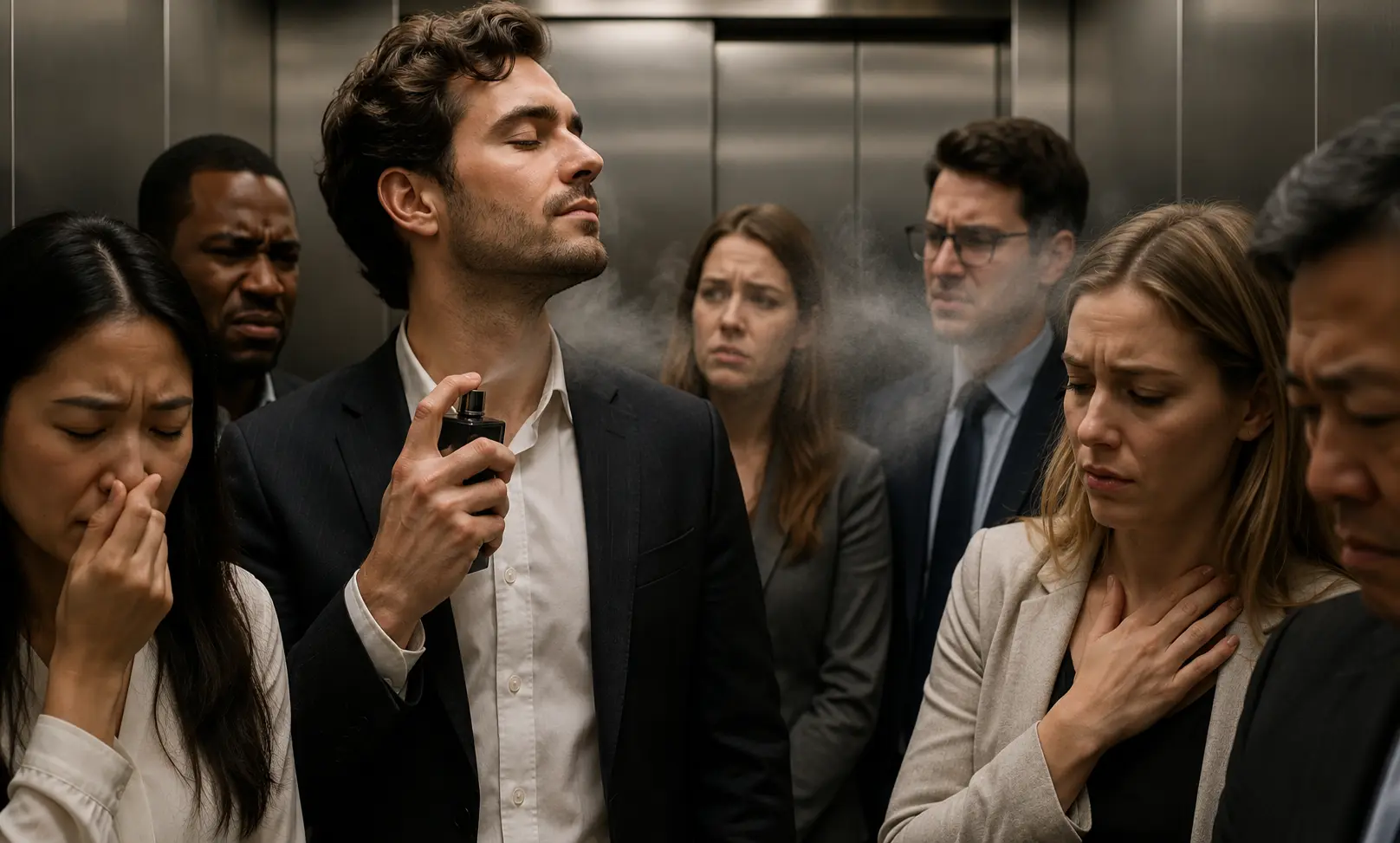
Elevators create a micro-environment where scent molecules accumulate quickly. Unlike outdoor spaces, there’s minimal air circulation, meaning:
- Fragrance lingers longer
- Projection feels stronger than intended
- People are exposed at close range
This is why a perfume that seems “normal” to you can feel intense to others—especially if you’ve developed mild nose blindness. If you’re unsure whether your scent crosses the line, this guide on How Do You Tell If Your Perfume Is Too Noticeable? explains clear signs to watch for.
⚠️ Types of Perfumes You Should Avoid in Elevators
1. Heavy Oud and Resin-Based Fragrances
Oud, incense, and resin-heavy scents are rich and complex—but in confined spaces, they can feel dense and suffocating.
Why avoid them?
- Strong projection
- Long-lasting molecular weight
- Can trigger discomfort or headaches
2. Intense Gourmand Scents (Sweet & Edible Notes)
Fragrances with notes like caramel, vanilla, chocolate, or syrupy sweetness may feel cozy—but in elevators, they can become cloying.
Common issue:
What smells “delicious” up close can feel overpowering in the air.
3. Animalic or Musky Fragrances
These include scents with civet, castoreum, or heavy synthetic musks.
Problem:
They can smell:
- Too intimate
- Too “skin-like”
- Or even unpleasant to some people
This explains why some individuals react negatively without saying anything. You can explore the psychology behind this in Why Do Some People React Negatively to Your Perfume Without Saying Anything?.
4. Over-Sprayed Fresh or Citrus Perfumes
Surprisingly, even fresh scents can be problematic—if over-applied.
Why?
- High alcohol diffusion = fast projection burst
- Creates a “cloud” effect in tight spaces
5. Loud Projection Designer or Niche Fragrances
Some perfumes are designed to fill a room—which is exactly what you don’t want in an elevator.
If you’ve ever wondered whether your scent is taking over a space, this guide on How Do You Know If Your Perfume Is Filling the Room? offers practical insights.
📊 Comparison Table: Safe vs. Risky Perfume Types in Elevators
| Perfume Type | Behavior in Elevators | Risk Level 🚨 | Why It’s Problematic |
|---|---|---|---|
| Oud / Resin-heavy | Dense, lingering | 🔴 High | Overwhelming in small spaces |
| Sweet Gourmand | Thick, cloying | 🔴 High | Becomes suffocating |
| Animalic / Heavy Musk | Intimate, polarizing | 🔴 High | Can smell unpleasant to others |
| Strong Citrus (overused) | Sharp, diffusive | 🟠 Medium | Creates scent cloud quickly |
| Light Fresh / Skin scents | Soft, close to skin | 🟢 Low | Safer for shared spaces |
🌡️ Hidden Factor: Sensitivity and Allergies
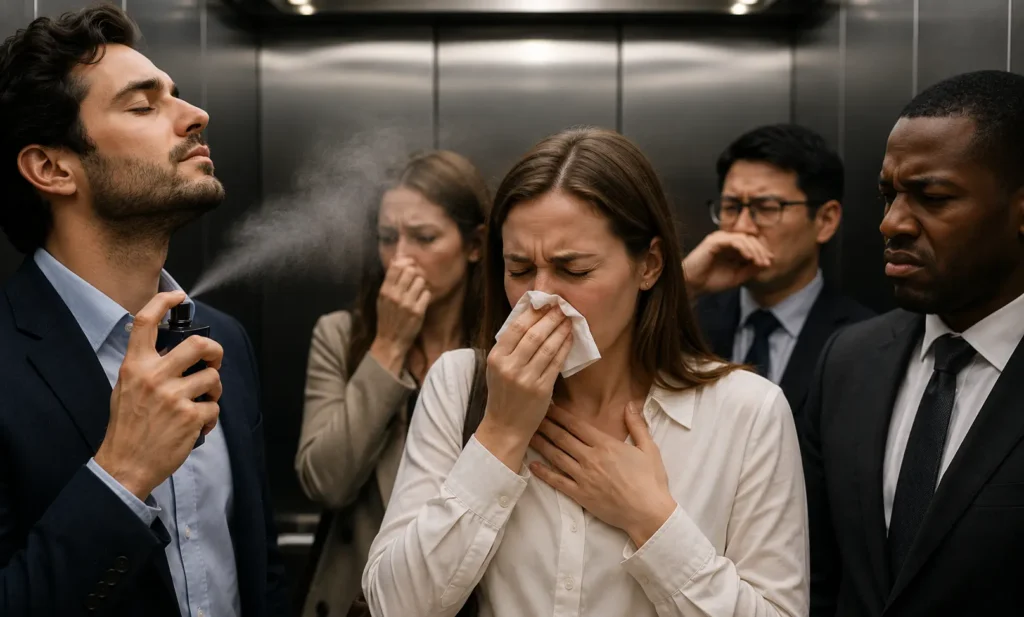
Elevators are high-risk environments for people with fragrance sensitivities or allergies. Even a moderate scent can trigger:
- Headaches
- Nausea
- Breathing discomfort
That’s why it’s important to consider safer fragrance choices. This article on What Perfume Should You Wear Around People with Allergies? explores better alternatives for shared environments.
Why do perfumes smell stronger in elevators?
Perfumes smell stronger in elevators because the space is enclosed, limiting airflow and causing scent molecules to accumulate. Close proximity between people intensifies perception, making even moderate fragrances feel overpowering.
🎯 The Smart Alternative: Go “Soft, Not Loud”
In elevator scenarios, the goal isn’t to impress with strength—it’s to avoid discomfort while staying pleasant.
Subtle, skin-like fragrances often create a better impression than loud, projecting ones. In fact, softer scents can feel more refined and socially aware. This concept is explored in depth in Does a “Soft” Perfume Create a Stronger Impression Than a Loud One?.
🧩 Practical Guidelines for Elevators
✔ Apply 1–2 sprays max
✔ Avoid pulse-point overloading (neck + wrists + clothes)
✔ Choose fragrances with low projection and soft diffusion
✔ Wait 5–10 minutes after spraying before entering confined spaces
❓ FAQ Section
❓ Is it rude to wear perfume in an elevator?
Not necessarily—but wearing strong or overpowering perfume in a confined space can be considered inconsiderate, especially if it affects others’ comfort.
❓ How many sprays are safe before entering an elevator?
Typically, 1–2 light sprays are enough. More than that increases the risk of overwhelming others in close proximity.
❓ Are fresh perfumes always safe in elevators?
Not always. Fresh perfumes can still be overpowering if over-applied due to their high diffusion rate.
❓ Why can’t I smell my perfume, but others can?
This is often due to olfactory fatigue, where your nose adapts to your scent. Others, however, experience it at full strength.
❓ What is the safest type of perfume for elevators?
Skin scents, light florals, and clean musks with low projection are generally the safest choices.
🧭 Final Thought
Elevators are a subtle but powerful test of your fragrance awareness. The best scent in this context isn’t the strongest or most expensive—it’s the one that respects the space and the people in it.
👉 Interactive Question:
Have you ever been in an elevator where someone’s perfume felt too strong—or were you unsure if yours was? Share your experience below.
Discover more from Perfume Cultures
Subscribe to get the latest posts sent to your email.




3 Comments