
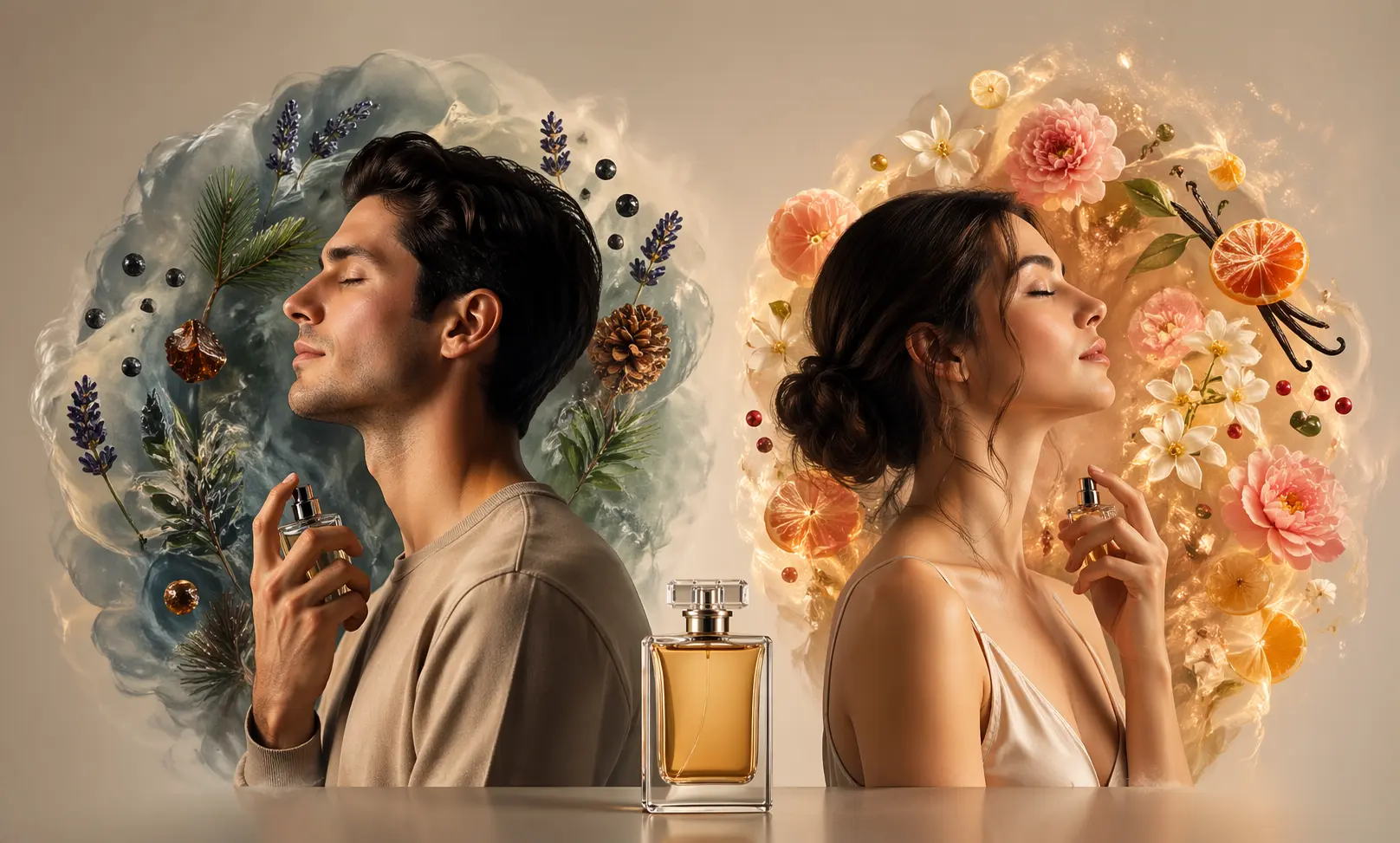
Why Same Perfume Smells Different on Two People
Perfume is often treated as a fixed product—spray it, smell it, judge it. But in reality, fragrance is not static. It’s a chemical and psychological interaction between the perfume and the person wearing it.
This is why the exact same fragrance can smell warm and smooth on one person, but sharp or flat on another.
Understanding why this happens isn’t just fascinating—it can completely change how you test, choose, and experience perfume.
🧪 The Science: Perfume Is Not Just a Smell—It’s a Reaction
At its core, perfume is a blend of aromatic molecules designed to evaporate at different speeds. Once applied, these molecules don’t exist in isolation—they interact with your skin.
This interaction is deeply explained in How Perfume Works: The Science Behind Fragrance, Molecules, and Human Smell, where the evaporation curve and molecular structure define how a scent unfolds over time.
But here’s the key insight:
A perfume doesn’t “release” its scent the same way on every surface—it reacts differently depending on the skin it touches.
🧬 Skin Chemistry: The Hidden Variable
The biggest reason perfumes smell different on two people is skin chemistry.
Factors include:
- Natural skin oils (sebum levels)
- Skin hydration
- pH balance
- Body temperature
These variables influence:
- How fast molecules evaporate
- Which notes become dominant
- How long each phase lasts
This is explored further in Why Does Perfume Smell Different on Skin?, where even slight variations in skin conditions can dramatically shift a fragrance’s profile.
On oily skin, perfumes often last longer and feel richer.
On dry skin, they may evaporate faster and feel sharper.
⏳ Time Matters: The Evolution Is Not the Same for Everyone
Perfume evolves in stages:
- Top notes (first impression)
- Heart notes (core identity)
- Base notes (long-lasting foundation)
But here’s the overlooked truth:
These stages don’t unfold at the same speed—or intensity—on every person.
This is why judging a perfume too quickly can be misleading. As explained in Why Your First Impression Of a Perfume Is Often Wrong, what you smell in the first few minutes is not the full story.
On one person:
- The top notes may fade quickly, revealing a warm base
On another:
- The top notes may linger longer, masking deeper layers
🧠 Perception: Your Brain Shapes What You Smell

Even if two people had identical skin chemistry (which they don’t), they still might describe the same perfume differently.
Why?
Because smell is processed through:
- Memory
- Emotion
- Personal experience
As discussed in Why You Like Scents You Can’t Describe, your brain doesn’t just detect scent—it interprets it.
A woody note might feel comforting to one person and overwhelming to another.
This means:
- The difference is not only chemical
- It’s also psychological
🧩 Complexity Amplifies Differences
Not all perfumes behave the same way across different people.
Simple fragrances:
- Fewer notes
- More predictable behavior
Complex fragrances:
- Multiple layers
- Greater variation between individuals
In What Makes a Perfume Smell Complex vs Simple, this distinction explains why niche or layered perfumes often smell dramatically different from one wearer to another.
The more complex the structure, the more room there is for variation.
🔬 Why This Matters More Than You Think
Understanding this concept changes how you approach fragrance:
✔️ You stop judging perfumes based on others’ opinions
✔️ You test fragrances on your own skin—not paper strips
✔️ You give scents time to evolve before deciding
Because in reality:
You’re not just smelling the perfume—you’re smelling the interaction between the perfume and you.
❓ FAQ Section
Why does the same perfume smell stronger on someone else?
This is often due to differences in skin oil and temperature. Oily or warmer skin can amplify projection and longevity.
Can diet or lifestyle affect how perfume smells?
Yes. Diet, hydration, and even stress levels can subtly influence skin chemistry, which in turn affects fragrance performance.
Why does a perfume smell good on paper but different on my skin?
Paper doesn’t have oils, heat, or pH. Your skin introduces variables that change how the scent develops.
Do expensive perfumes behave more consistently across people?
Not necessarily. In fact, complex or high-quality perfumes may show more variation because of their layered composition.
Is there a way to predict how a perfume will smell on me?
Not perfectly. The best method is to test it on your own skin and observe how it evolves over several hours.
🧭 Final Insight
Perfume is not a fixed experience—it’s a personal chemical signature.
Two people can wear the same fragrance…
But the result is never truly identical.
❓ Interactive Question
Have you ever tried a perfume that smelled amazing on someone else—but completely different on you? What do you think caused that difference?
Discover more from Perfume Cultures
Subscribe to get the latest posts sent to your email.




2 Comments