
How Do Perfumers Remember Thousands of Smells?
Imagine walking into a room and instantly identifying hundreds—sometimes thousands—of distinct scents with precision. This is not a superpower. It’s the result of training, neuroscience, and a deep understanding of how smell works.
Perfumers don’t rely on “good noses” alone—they build structured scent memory systems that allow them to recognize, store, and recall aromas with remarkable accuracy. But how exactly does this happen?
Let’s break it down scientifically and practically.
🧠 The Brain Behind Smell Memory
Unlike vision or hearing, smell is directly wired to the brain’s emotional and memory centers—specifically the limbic system. This is why scent memory can feel instant and powerful.
To understand this deeper, it helps to revisit how scent is processed at a molecular level in How Perfume Works: The Science Behind Fragrance, Molecules, and Human Smell—because before a perfumer can remember a scent, their brain must first correctly interpret it.
Perfumers train their brains to:
- Recognize individual molecules
- Associate them with categories (woody, floral, resinous)
- Store them in long-term memory through repetition
This transforms smell from a vague sensation into a structured mental library.
🔍 Why Smell Is Hard to Describe (But Easy to Remember)
You’ve probably experienced this: you recognize a smell instantly, but struggle to describe it.
That’s because scent perception operates differently from language. As explored in Why You Like Scents You Can’t Describe, the brain often processes smell in a non-verbal way—meaning recognition happens faster than articulation.
Perfumers solve this by:
- Building a personal scent vocabulary
- Associating smells with objects, places, or experiences
- Using standardized training kits (like aroma wheels or scent strips)
Over time, what was once “indescribable” becomes clearly defined.
❤️ Emotional Memory: The Secret Weapon
Smell is not just chemical—it’s emotional.
In fact, research shows that scent is the most emotionally powerful sense, which is why a single note can trigger vivid memories. This concept is explored further in Why Smell Is the Most Emotional Human Sense.
Perfumers leverage this by:
- Linking scents to emotional anchors (e.g., “warm vanilla = comfort”)
- Using memory triggers to strengthen recall
- Practicing mindful smelling—focusing deeply on each scent experience
This emotional tagging makes scent memory stickier and more retrievable.
🧪 Training Like a Perfumer: Repetition and Isolation
Perfumers don’t memorize perfumes—they memorize raw materials first.
They train using a method called isolation:
- Smell one ingredient at a time (e.g., bergamot, patchouli, iso e super)
- Repeat exposure daily
- Test recall without visual cues
Over time, they build a mental “database” of scent profiles.
But real mastery comes from understanding how these materials behave in context—especially on skin. That’s why studying how scent evolves in real conditions, like in Why Does Perfume Smell Different on Skin?, is essential for developing accurate memory.
Because remembering a smell isn’t enough—you must remember how it changes.
🧩 Layered Thinking: From Notes to Structures
Perfumers don’t think in “one smell”—they think in layers.
Instead of memorizing a perfume as a whole, they break it down into:
- Top notes (fresh, volatile)
- Heart notes (core identity)
- Base notes (long-lasting foundation)
This aligns with the idea of complexity in fragrance composition, explored in What Makes a Perfume Smell Complex vs Simple.
By analyzing structure, perfumers:
- Recognize patterns across different fragrances
- Group similar compositions together
- Reduce thousands of scents into manageable systems
This is similar to how musicians recognize chords instead of individual notes.
🧠 The “Olfactory Library” Concept
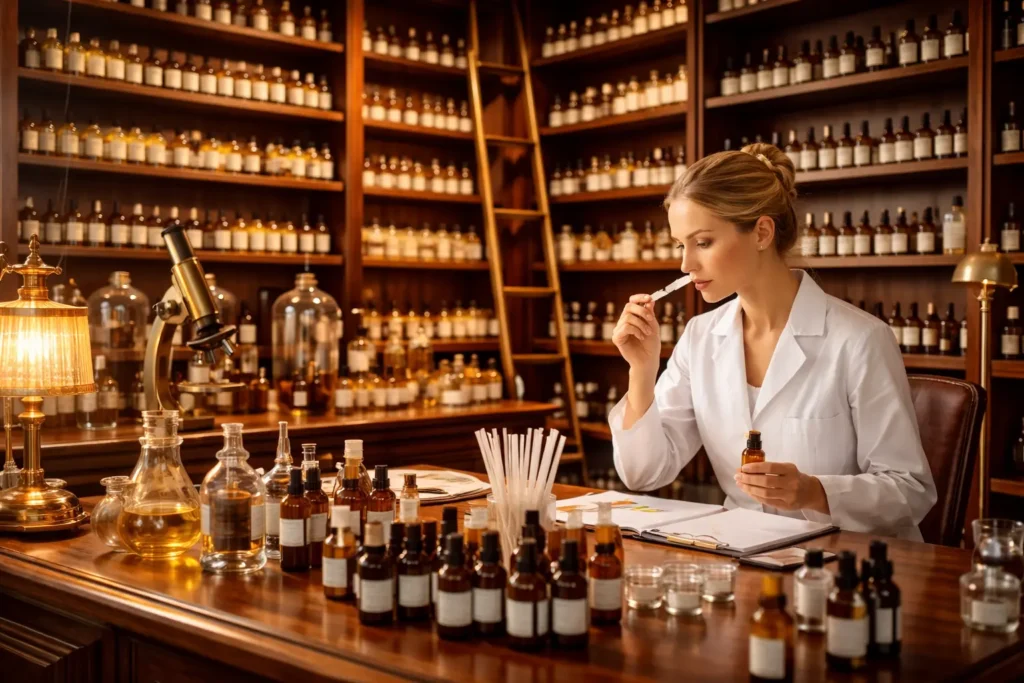
Over time, perfumers build what’s often called an olfactory library—a mental catalog of scents.
This library is organized by:
- Scent families (citrus, woody, oriental, gourmand)
- Chemical similarities
- Emotional and experiential associations
Instead of remembering 1,000 random smells, they remember:
👉 Patterns
👉 Categories
👉 Relationships
This dramatically reduces cognitive load and improves recall speed.
🔁 Continuous Practice: Memory Never Stops
Even experienced perfumers continue training daily.
Their routine often includes:
- Smelling dozens of raw materials each morning
- Revisiting familiar scents to reinforce memory
- Testing themselves through blind evaluations
This constant exposure prevents memory decay and sharpens perception.
❓ FAQ Section
❓ How many scents can a perfumer realistically remember?
Most trained perfumers can recognize hundreds to thousands of raw materials and combinations, depending on experience and training.
❓ Do perfumers have better noses than normal people?
Not necessarily. Their advantage comes from training, repetition, and structured memory systems, not genetics alone.
❓ How long does it take to train scent memory?
Basic training can take months, but professional-level memory often requires years of consistent practice.
❓ Why do some people struggle to remember smells?
Because scent is often not processed verbally. Without training or conscious attention, smells remain vague and harder to recall.
❓ Can anyone improve their scent memory?
Yes. With consistent exposure, mindful smelling, and categorization, anyone can significantly improve their olfactory memory.
🧭 Final Thoughts
Perfumers don’t just “remember smells”—they understand them, categorize them, and emotionally connect with them.
What seems like an impossible feat is actually a combination of:
- Science (how smell works)
- Psychology (how memory and emotion interact)
- Practice (daily repetition and analysis)
Together, these create a powerful system where thousands of scents are no longer overwhelming—but organized, familiar, and instantly recognizable.
❓ Interactive Question:
If you had to train your nose like a perfumer, which scent would you start with—and why?
Discover more from Perfume Cultures
Subscribe to get the latest posts sent to your email.