
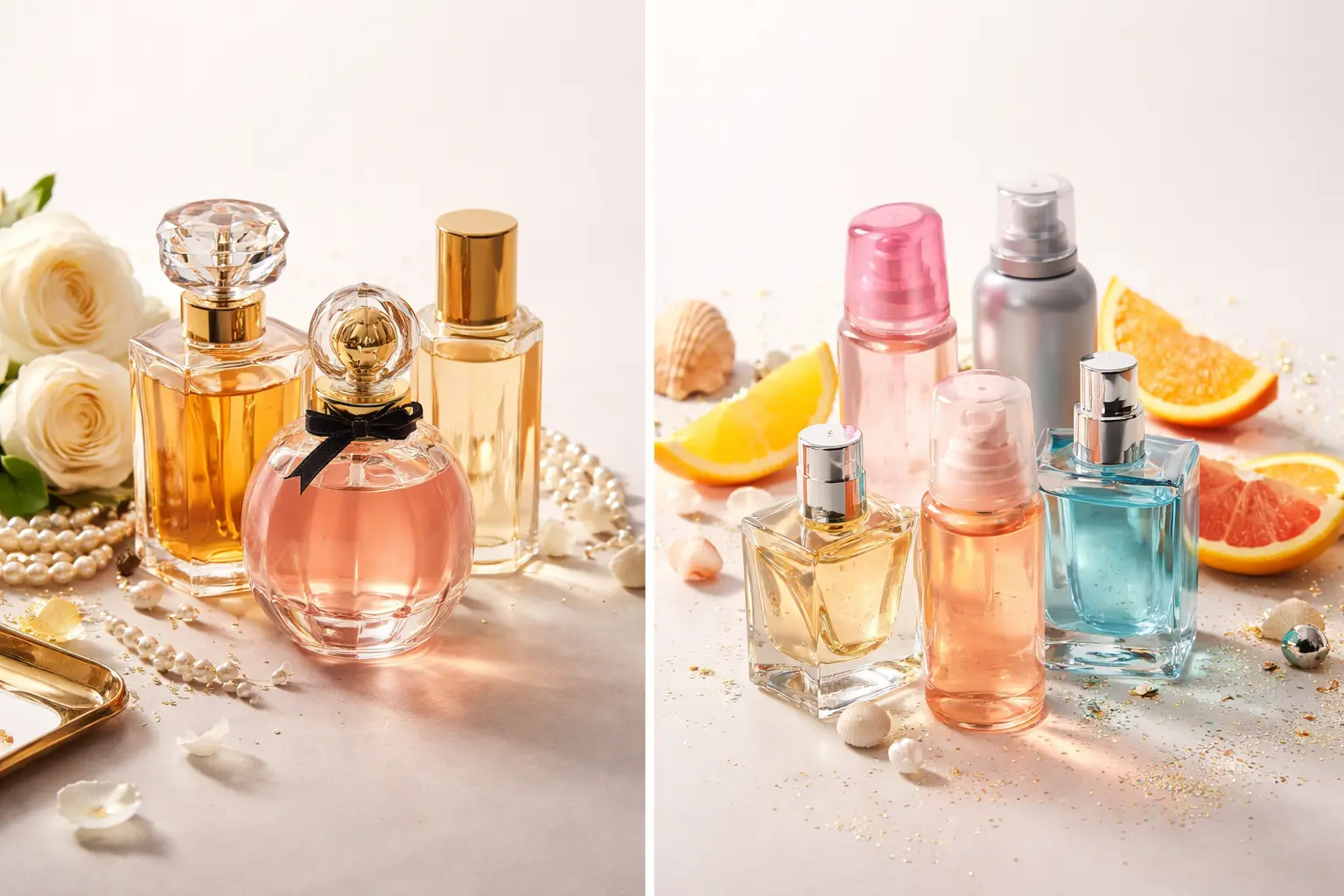
Why Do Some Perfumes Smell Cheap (Even When They’re Expensive)?
At first glance, price should equal quality. Yet in the world of fragrance, that assumption often breaks down. You may spray a luxury perfume—only to feel it smells flat, synthetic, or strangely “cheap.”
So what’s really going on?
This isn’t just about ingredients or brand reputation. The perception of a “cheap-smelling” perfume is shaped by a complex mix of chemistry, design strategy, and human psychology. Let’s break it down.
🧠 The Foundation: How Perfume Is Built
Before judging a fragrance, it’s essential to understand how it works at a molecular level. Perfumes are not just scents—they are carefully engineered structures made of volatile compounds that evaporate at different rates.
👉 This is explained deeply in How Perfume Works: The Science Behind Fragrance, Molecules, and Human Smell
A perfume can smell “cheap” when:
- It relies heavily on fast-evaporating top notes
- It lacks depth in heart and base notes
- The transitions between notes feel abrupt or linear
✔ In short: a weak structure often feels less luxurious—even if the materials are expensive.
⚖️ Simple vs Complex: The Real Indicator of Quality
One of the strongest signals of a “cheap” impression is lack of complexity.
👉 Explore this deeper in What Makes a Perfume Smell Complex vs Simple
Complex perfumes:
- Evolve over time
- Reveal multiple layers
- Create a journey on the skin
Simple (or linear) perfumes:
- Smell the same from start to finish
- Feel predictable
- Lack emotional engagement
✔ Even a high-priced fragrance can feel cheap if it smells too simple or repetitive.
🎯 The Hidden Strategy: Designed to Please Everyone
Here’s a surprising truth: some expensive perfumes are intentionally designed to be “safe.”
👉 Learn more in Are “Mass Appealing” Perfumes Engineered to Be Safe?
Mass-appealing fragrances often:
- Avoid bold or unusual notes
- Use familiar scent profiles (fresh, sweet, clean)
- Minimize risk to attract a wider audience
But this comes with a trade-off:
➡️ Familiarity can be mistaken for cheapness.
When a scent feels too common or reminds you of everyday products (like shampoos or air fresheners), your brain may label it as low-value—even if it’s not.
🎭 The Psychological Effect: Your Brain Decides Value

Not all “cheap” impressions come from the perfume itself. Sometimes, the issue is perception.
👉 This is explored in Why You Like Scents You Can’t Describe
Your brain:
- Associates certain smells with past experiences
- Struggles to interpret unfamiliar scent structures
- Labels what it can’t process as “off” or “cheap”
For example:
- A complex woody-amber scent might feel confusing
- Instead of appreciating it, your brain rejects it
✔ Result: The fragrance isn’t cheap—your brain just doesn’t recognize its value.
🧪 Texture Matters: Smooth vs Harsh Sensations
Another overlooked factor is how a perfume feels, not just how it smells.
👉 Dive deeper here: Why Some Perfumes Feel Smooth While Others Feel Harsh
Harsh perfumes:
- Have sharp, piercing notes
- Feel “chemical” or aggressive
- Lack blending between ingredients
Smooth perfumes:
- Flow seamlessly between notes
- Feel rounded and balanced
- Create a soft, natural impression
✔ A harsh texture can instantly make a fragrance feel synthetic—and therefore “cheap.”
🧬 When Expensive Ingredients Still Feel Cheap
Even high-quality materials can fail if:
- They are poorly balanced
- Overdosed (too strong in one direction)
- Combined without harmony
Luxury doesn’t come from ingredients alone—it comes from composition and execution.
🧳 Context & Expectations: The Invisible Influence
Sometimes, the issue isn’t the perfume—it’s the expectation.
If you:
- Expect richness but get freshness
- Expect uniqueness but get familiarity
Your brain experiences a mismatch.
✔ And that mismatch often gets labeled as:
👉 “This smells cheap.”
❓ FAQ: Understanding “Cheap-Smelling” Perfumes
Why does an expensive perfume sometimes smell synthetic?
Because of how ingredients are blended. Even high-quality materials can feel synthetic if they are too sharp or poorly balanced.
Does simple always mean cheap?
Not necessarily. Minimalist perfumes can be elegant—but if they lack evolution or depth, they may feel less valuable.
Are mass-appealing perfumes lower quality?
No—but they are designed to be safe and familiar, which can sometimes reduce their perceived uniqueness.
Can my perception of a perfume change over time?
Yes. As your nose becomes more experienced, you may begin to appreciate scents you once found “cheap.”
Is harshness a sign of low quality?
Often, yes. A harsh or unblended scent can feel less refined, even if the ingredients are expensive.
🧭 Internal Insight: What You Should Really Look For
Instead of focusing on price, evaluate a perfume based on:
✔ Complexity
✔ Smooth transitions
✔ Balance of notes
✔ Emotional impact
These are the true indicators of quality—not the label on the bottle.
❓ Final Thought
Have you ever tried a luxury perfume that smelled surprisingly “cheap” to you—and then later changed your mind after wearing it longer?
Discover more from Perfume Cultures
Subscribe to get the latest posts sent to your email.





One Comment