
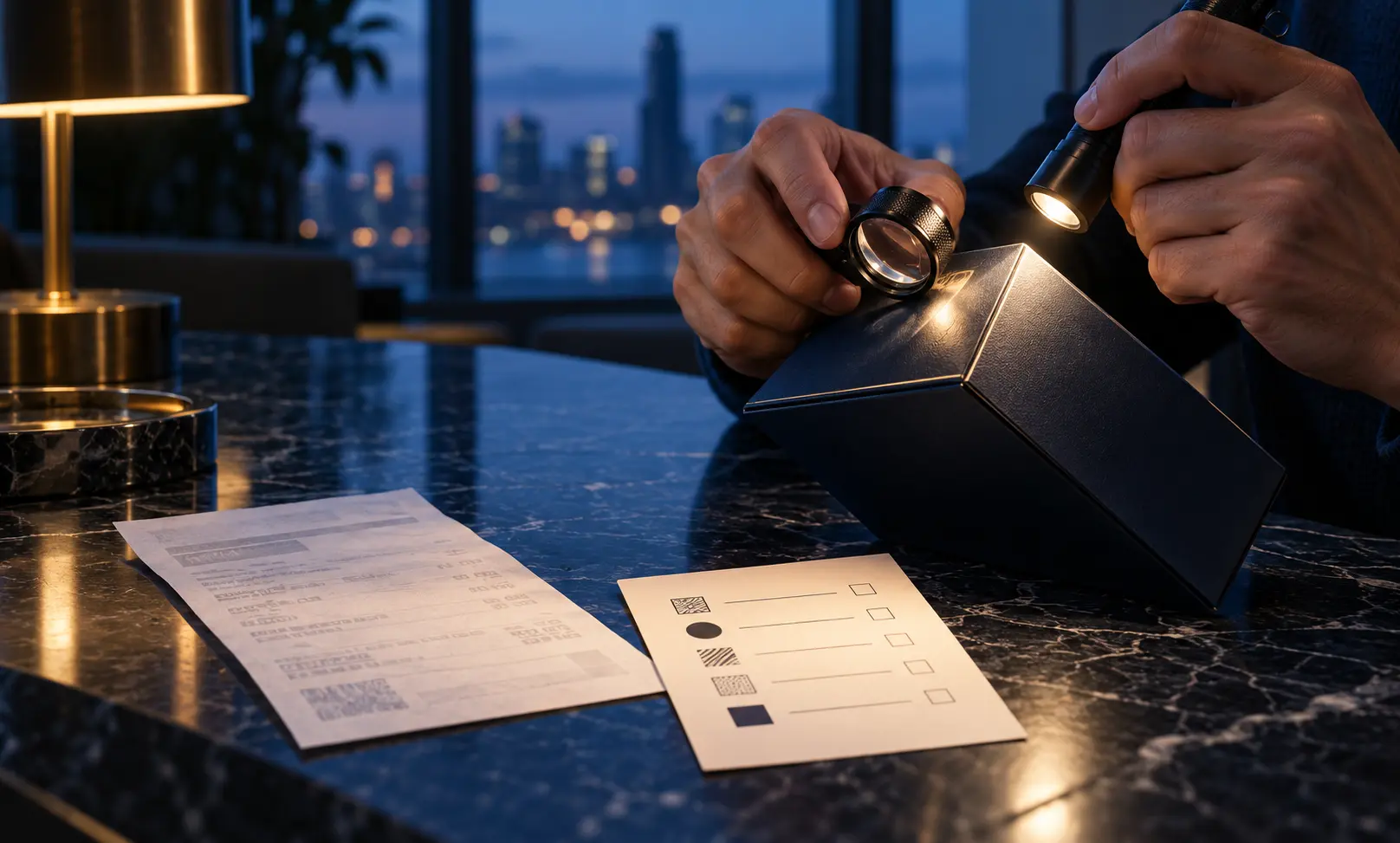
How to Tell if Bleu de Chanel Is Real or Fake
Buying Bleu de Chanel should feel exciting—not like a gamble. Yet its popularity, premium price, and instantly recognizable name make it a frequent target for counterfeit sellers. A fake bottle can look convincing in a listing photo, especially when it is sealed, discounted, or sold through an unfamiliar marketplace account.
The good news: you do not need to become an expert collector to reduce the risk. You simply need to assess the source, packaging, bottle, atomizer, codes, and scent as a complete picture. One imperfect detail does not automatically mean your bottle is fake—but several inconsistencies together deserve attention.
How can you tell if Bleu de Chanel is real?
Check where it was purchased first, then inspect the box quality, bottle weight, cap fit, atomizer, printing, and batch code. Authentic Bleu de Chanel bottles usually show consistent, precise construction. However, no single detail—including a batch code or liquid color—can prove authenticity on its own.
🔎 The Most Reliable Way to Avoid a Fake
The most reliable authenticity check happens before you buy: choose a reputable retailer with clear product photos, customer service, a return policy, and a realistic price.
A perfectly copied bottle can still pass a quick visual inspection. A trustworthy seller, however, dramatically lowers the chance that you will ever need to investigate the bottle in the first place. If you are deciding where to purchase, see Where to Buy Authentic Bleu de Chanel at the Best Price.
The safest way to avoid a fake is buying from a verified retailer.
📦 Start With the Box, Not the Fragrance
Counterfeiters often focus on making the front of the box look convincing because that is what buyers notice first. Take your time with the smaller details instead.
An authentic Bleu de Chanel box should generally feel clean, substantial, and carefully finished. The lettering should look sharp rather than fuzzy, the spacing should appear even, and the label information should not look crooked or cheaply applied. Seams should be neat, and the cellophane should look professionally wrapped—not excessively loose, wrinkled, or glued in a messy way.
Still, packaging can vary between production years, bottle sizes, regions, and reformulations. A slightly different logo placement or box finish is not enough to declare a bottle fake. If your concern is specifically about a packaging difference, read Why Does My Bleu de Chanel Packaging Look Different?.
| What to inspect | Usually reassuring | Potential warning sign |
|---|---|---|
| Printing | Crisp text with clean edges | Blurry, uneven, or poorly aligned lettering |
| Box construction | Firm cardboard and tidy seams | Flimsy material, rough edges, or messy glue |
| Product label | Straight, readable, and complete | Crooked label, spelling errors, or missing details |
| Cellophane | Neatly fitted and sealed | Loose wrap, excessive wrinkles, or cheap-looking seams |
🧴 Inspect the Bottle’s Build Quality
Once you open the box, the bottle should feel like a premium product. Bleu de Chanel bottles are typically substantial, balanced, and carefully finished. Look at the glass from several angles under normal light.
Pay attention to the base, edges, logo, and printed text. The printing should look controlled and durable—not thick, glossy, smudged, or easily scratched. The bottle should not have obvious uneven glass, air bubbles, sharp rough edges, or a visibly off-center label area.
The cap should fit securely and sit neatly on the bottle. Do not judge authenticity only by whether the cap is magnetic or by one video comparison online; bottle construction and cap details may vary by version and production period. Instead, ask whether the whole bottle feels consistent with the quality expected from Chanel.
Is a loose cap a sign that Bleu de Chanel is fake?
Not necessarily. A loose cap can be a warning sign when it appears alongside poor printing, weak bottle construction, or a suspicious seller. On its own, it is not enough to prove that a Bleu de Chanel bottle is counterfeit.
💨 Test the Atomizer and Spray
The atomizer is one of the most useful practical checks because it is difficult to imitate perfectly at a low cost. An authentic bottle should generally produce a controlled, fine mist rather than a harsh stream, drips, or random splashes.
Press the sprayer a few times after priming it. The button should feel stable, the spray should distribute evenly, and the collar around the atomizer should not look loose or badly assembled. A fake may have a cheap-feeling sprayer, but remember that shipping damage, age, or a manufacturing issue can also affect a genuine atomizer.
| Feature | Authentic bottles often show | Counterfeit bottles may show |
|---|---|---|
| Spray | Fine, even mist | Narrow stream, sputtering, or dripping |
| Atomizer button | Stable and smooth to press | Loose, wobbly, or rough operation |
| Bottle finish | Clean, precise assembly | Uneven edges or poorly fitted components |
| Overall feel | Heavy, refined, and consistent | Light, cheap, or visibly inconsistent |
🔢 Check the Batch Code—but Do Not Rely on It Alone
The batch code is useful because it can reveal whether the code on the bottle and box matches and whether it appears professionally applied. Look for a code that is clear, consistent, and placed neatly. A missing code, a mismatched code, or a code that looks like a removable sticker should make you more cautious.
However, counterfeiters can copy batch codes. Some fake bottles use real-looking codes, while legitimate packaging details can vary by run. Treat the batch code as one piece of evidence—not a final verdict. For a fuller explanation of what a code can and cannot tell you, see Bleu de Chanel Batch Code Explained.
🎨 Does the Liquid Color Reveal a Fake?
Not by itself. Lighting, bottle tint, age, photography, and version differences can make the liquid look slightly different from another bottle or an online image. A color difference becomes more relevant only when it appears with other problems, such as poor packaging, an incorrect scent, or a suspiciously cheap price.
Avoid making a decision based on “my liquid looks lighter” or “the color seems darker than a sample.” Instead, compare the whole experience: the source, the bottle, the atomizer, the code, and the scent development. For a closer look at normal variation, read Why Is My Bleu de Chanel Liquid a Different Color?.
👃 Compare the Scent in Stages, Not Just the Opening
A fake may smell pleasant for the first few minutes and still fail to resemble the authentic fragrance as it dries down. Test your bottle on skin or a blotter, then give it time. Bleu de Chanel should feel composed and evolving rather than flat, harsh, or dominated by a single chemical-smelling note from start to finish.
That said, scent perception is not perfectly consistent. Skin chemistry, storage conditions, bottle age, formulation changes, and nose blindness can all change how a fragrance seems to perform. Authentic bottles may not smell identical to one another, so a small difference does not automatically mean you have a counterfeit. Learn more in Do All Bleu de Chanel Bottles Smell the Same?.
If you are comparing your bottle with a small sample or decant, be especially careful. Samples can age differently, be stored differently, or come from another version or batch. This guide explains why that comparison can be misleading: Why Does My Bleu de Chanel Full Bottle Smell Different from a Sample or Decant?.
🚩 Warning Signs Before You Pay
A very low price is not automatic proof of a fake, especially during legitimate promotions or when a retailer is clearing inventory. But a price that is dramatically lower than every reputable seller should make you stop and investigate.
Be more cautious when a listing has several of these signs:
- The seller has little feedback, vague contact details, or no return policy.
- The listing uses only stock photos and refuses to show the actual box or bottle.
- The price seems unrealistically low for a sealed current bottle.
- The description contains spelling errors, generic wording, or inconsistent bottle-size information.
- The seller pressures you to pay outside the marketplace or through an unprotected payment method.
- The product is described as “inspired by,” “tester style,” or “factory original” without a clear explanation.
Before buying from an unfamiliar seller, ask for clear photos of the actual bottle, bottom label, box code, and atomizer. A legitimate seller should not be offended by reasonable questions about a high-value fragrance.
🛍️ What to Do If You Suspect Your Bottle Is Fake
Do not panic after finding one small inconsistency. First, document what you have: the order confirmation, seller name, listing screenshots, photos of the box and bottle, batch code, and any communication with the seller.
Then compare the bottle against several reliable references and assess the full pattern. If you bought from a retailer or marketplace with buyer protection, contact them promptly and request a review or return. Do not keep testing the product on your skin if you are concerned about its safety or unknown ingredients.
If the seller will not cooperate, your evidence will be far more useful than a simple statement that “the smell seems off.”
✅ Final Verdict: Authenticity Is About the Full Picture
The best way to tell whether Bleu de Chanel is real or fake is not to obsess over one detail. Check the retailer first, then evaluate the packaging, bottle quality, atomizer, batch code, and scent together.
A genuine bottle can have a minor packaging variation. A fake can copy a convincing code. But when the source is unreliable and several details feel wrong at once, trust that pattern—and use your return protection before it is too late.
For your next purchase, choose a verified retailer, compare the price with established stores, and keep your order documentation. That is the simplest, safest way to enjoy Bleu de Chanel with confidence.
❓ Frequently Asked Questions
Can a real Bleu de Chanel bottle have a different batch code from the box?
It should normally match the code shown on its original box. A mismatch deserves investigation, but check that you are comparing the bottle with its correct box and not packaging from another product.
Can I verify Bleu de Chanel only by scanning a barcode?
No. Barcodes can be copied, reused, or printed on counterfeit packaging. They are useful as part of a broader check, not as proof of authenticity.
Is Bleu de Chanel from a discount retailer always fake?
No. Authorized or established discount retailers may sell genuine stock at lower prices. The concern is not simply the discount—it is whether the seller is credible, transparent, and protected by a clear return policy.
Does weak performance mean my Bleu de Chanel is fake?
Not necessarily. Temperature, dry skin, nose blindness, storage, and version differences can affect perceived performance. Look for several signs before reaching a conclusion.
What should I do if I cannot confirm whether my bottle is authentic?
Contact the retailer with your photos and order details, request a return if available, and avoid treating any single online comparison as conclusive.
Discover more from Perfume Cultures
Subscribe to get the latest posts sent to your email.




3 Comments