How to Tell if a Bleu de Chanel Sample Is Authentic
Buying a Bleu de Chanel sample should be the inexpensive way to decide whether the fragrance suits you—not a gamble that leaves you wondering whether you smelled the real thing. The difficulty is that samples can come in several forms: official Chanel vials, retailer samples, and decants filled by a third party. They do not all look alike, but that does not automatically make them fake.
Before deciding whether a sample is authentic, understand whether Bleu de Chanel samples are worth buying. A genuine small sample can save you from spending heavily on the wrong full bottle; a suspicious one can create a completely false impression of the fragrance.
How can you tell if a Bleu de Chanel sample is real?
Check the seller first, then examine the vial’s presentation, label quality, atomizer, liquid condition, and scent development. A real sample should smell balanced from the citrusy opening into its woody, aromatic dry-down—not harsh, oily, or flat. However, an authentic decant may look plain because it was transferred from a genuine bottle by a reputable seller.
🔎 First, Identify What You Actually Bought
The most common mistake is assuming every authentic Bleu de Chanel sample must arrive in a branded Chanel vial. Official samples may have Chanel branding, but retailer samples and decants can use simple clear atomizers with printed labels.
That is why it helps to understand Bleu de Chanel Sample vs Decant: What Is the Difference?. An official sample is supplied by Chanel or an authorized retailer; a decant is fragrance transferred from a full bottle. A decant can be authentic even when its atomizer is not branded.
| Type of product | What it usually looks like | Can it be authentic? |
|---|---|---|
| Official sample | Small branded vial, carded sample, or retailer discovery vial | Yes |
| Retailer sample | May be branded or packaged by the store | Yes, if the retailer is reliable |
| Decant | Plain glass atomizer with a printed label | Yes, if filled from a genuine bottle |
| Suspicious “sample” | Poor label, vague listing, extremely low price, no seller details | Possibly not |
A plain vial is not the problem. A seller who cannot clearly explain what they are selling often is.
📦 Examine the Packaging and Presentation
If your sample arrived in official branded packaging, inspect it closely. Chanel presentation is generally clean, controlled, and consistent. Text should be crisp, spelling should be correct, and the printing should not look blurry or uneven.
Do not expect every genuine sample to have the same cardboard card, vial size, or label layout. Chanel changes promotional materials, retailers may package samples differently, and different markets can receive different formats.
Look for these warning signs:
- Misspelled words such as “Chanelle,” “Bleu De Channel,” or incorrect concentration names.
- Blurry logos, low-quality printing, crooked labels, or ink that rubs away easily.
- A vague label that does not name the version: EDT, EDP, Parfum, or L’Exclusif.
- Packaging that claims to be “official” but offers no batch information, retailer identity, or product details.
- A seller using only stock images and refusing to show the exact item you will receive.
🧴 Check the Vial, Atomizer, and Label
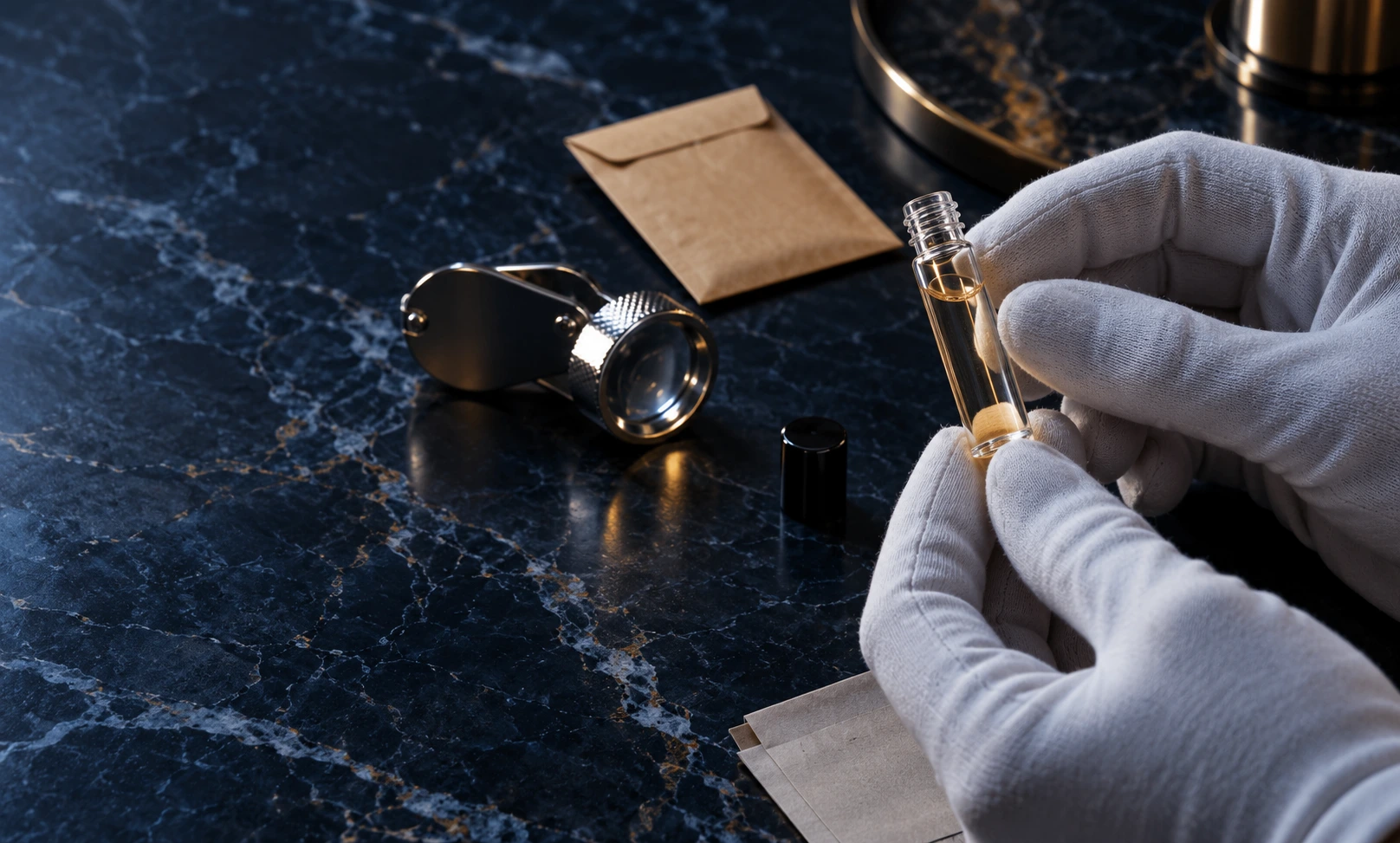
A genuine official sample usually feels neat and functional, even when it is small. The vial should close properly, the spray should work smoothly, and the liquid should not leak around the neck.
For decants, the quality of the atomizer is less important than the quality of the seller. A good decanter may use a simple glass vial, but the label should still clearly identify the fragrance and version.
| Detail to inspect | Usually reassuring | Potential red flag |
|---|---|---|
| Label | Clear name and version, straight application | Blurry, missing version, spelling errors |
| Atomizer | Fine, even spray with a secure cap | Leaking, sputtering, loose cap |
| Liquid | Clear and clean, without visible debris | Cloudiness, particles, oily residue |
| Fill level | Reasonable for the stated size | Noticeably underfilled or unexplained variation |
| Seller information | Store identity, policies, real photos | Anonymous listing and no return policy |
A poor spray mechanism alone does not prove the fragrance is fake—especially with decants—but several warning signs together should make you stop before buying again.
👃 Judge the Scent by Its Development, Not the First Spray
Bleu de Chanel should not smell like harsh rubbing alcohol for more than a brief moment after spraying. The opening varies by version, but you should normally notice freshness, citrus, aromatic notes, woods, and a polished masculine structure as it develops.
A fake sample may smell aggressively sharp, overly sweet, thin, or strangely chemical from beginning to end. It may also disappear so quickly that there is no meaningful dry-down. Still, performance alone is not conclusive: skin type, climate, storage, and nose blindness can all change your experience.
The best test is to spray it on clean skin, wait 20 to 30 minutes, then smell it again. An authentic fragrance should feel more blended as it settles rather than collapsing into a single artificial note.
If your sample smells different from a bottle you tried elsewhere, do not conclude immediately that it is counterfeit. Read Why Does My Bleu de Chanel Full Bottle Smell Different from a Sample or Decant? to account for storage, age, concentration, skin chemistry, and the possibility that you compared different versions.
Does a different smell mean a Bleu de Chanel sample is fake?
No. Bleu de Chanel can smell different depending on whether you tested EDT, EDP, Parfum, or L’Exclusif, as well as storage conditions and skin chemistry. A fake is more likely when the scent is persistently harsh, flat, oddly sweet, or inconsistent with the product listing and seller details.
⚖️ Make Sure You Are Comparing the Same Version
Bleu de Chanel EDT is not supposed to smell exactly like EDP, Parfum, or L’Exclusif. They share the same family identity, but their freshness, woods, richness, and depth differ. Comparing an EDT sample with an EDP counter tester can make a genuine sample seem “wrong.”
Before judging authenticity, confirm:
- The exact version written on the sample.
- The concentration you tested in-store.
- Whether the seller used the correct product images and description.
- Whether you bought a sample in a size that makes sense for a real test.
For a useful test, you need enough fragrance to wear it more than once. See What Bleu de Chanel Sample Size Should You Buy? before purchasing, because a tiny one-spray vial may be authentic but still too small to judge performance, dry-down, or your real reaction to it.
💸 Treat an Unrealistically Low Price as a Warning
Bleu de Chanel is a premium designer fragrance with consistent demand. A modest discount can be normal, especially for a decant, but an offer that looks dramatically cheaper than every established seller deserves closer inspection.
Be cautious when a listing has several of these signals:
- A price far below comparable samples or decants.
- “Tester” or “sample” used without a clear explanation.
- No information about the concentration or sample size.
- No images of the actual vial.
- No return policy or customer-service contact.
- Reviews that look copied, generic, or unrelated to fragrance.
The safest decision is usually to buy from a specialist seller that identifies the exact version, size, and condition clearly. For a practical starting point, use Where to Buy Bleu de Chanel Samples Online and choose a seller whose reputation matters more than saving a few dollars.
🛍️ Buy the Right Sample Before You Investigate It
The most reliable way to avoid a fake is to reduce the chance of encountering one. Choose an established retailer, fragrance-decant specialist, or official Chanel source. Read the listing carefully and make sure it tells you whether you are receiving an official sample or a decant.
Then choose the version with a purpose. If you want a brighter everyday scent, start with one option; if you want richer, smoother woods, start with another. Which Bleu de Chanel Version Should You Sample First? will help you select the right concentration before you spend money on multiple vials.
✅ What to Do If You Suspect Your Sample Is Fake
Do not throw it away immediately. Take photos of the vial, label, packaging, invoice, and product listing. Compare the seller’s description with what you actually received, then contact the seller calmly and request clarification or a refund if the item was misrepresented.
If the seller cannot identify the version, cannot explain the source, or dismisses clear quality concerns, avoid buying from them again. Do not use a questionable sample as your final judgment of Bleu de Chanel. One unreliable vial should not decide whether you buy—or avoid—a fragrance with several genuinely distinct versions.
❓ FAQ
Can a plain Bleu de Chanel sample vial be authentic?
Yes. Plain vials are common for decants and some retailer-made samples. Authenticity depends more on the source, clear labeling, and scent quality than on whether the atomizer carries Chanel branding.
Does an official Bleu de Chanel sample always have a batch code?
Not necessarily. Small promotional samples may show limited information, and decants normally use a label created by the seller. A missing code is a reason to investigate further, not proof of a fake.
Is a weak Bleu de Chanel sample counterfeit?
Not always. You may be nose-blind, testing a lighter concentration, applying too little, or comparing it with a different version. Check the scent again after 20 to 30 minutes before deciding.
Should I buy a full bottle after liking a sample?
Yes—if the sample came from a trustworthy source and you tested it on your skin several times. Buy the full bottle from a reputable retailer so you can be confident that your experience matches the fragrance you enjoyed.
Final Verdict
An authentic Bleu de Chanel sample does not need to look luxurious, but it should make sense: a credible seller, accurate labeling, clean liquid, a functional atomizer, and a scent that develops naturally rather than staying harsh or artificial.
Trust the full pattern, not one detail. When the seller is transparent and the sample performs like a polished Bleu de Chanel fragrance should, you can test with confidence—and make your full-bottle decision without second-guessing every spray.
Discover more from Perfume Cultures
Subscribe to get the latest posts sent to your email.