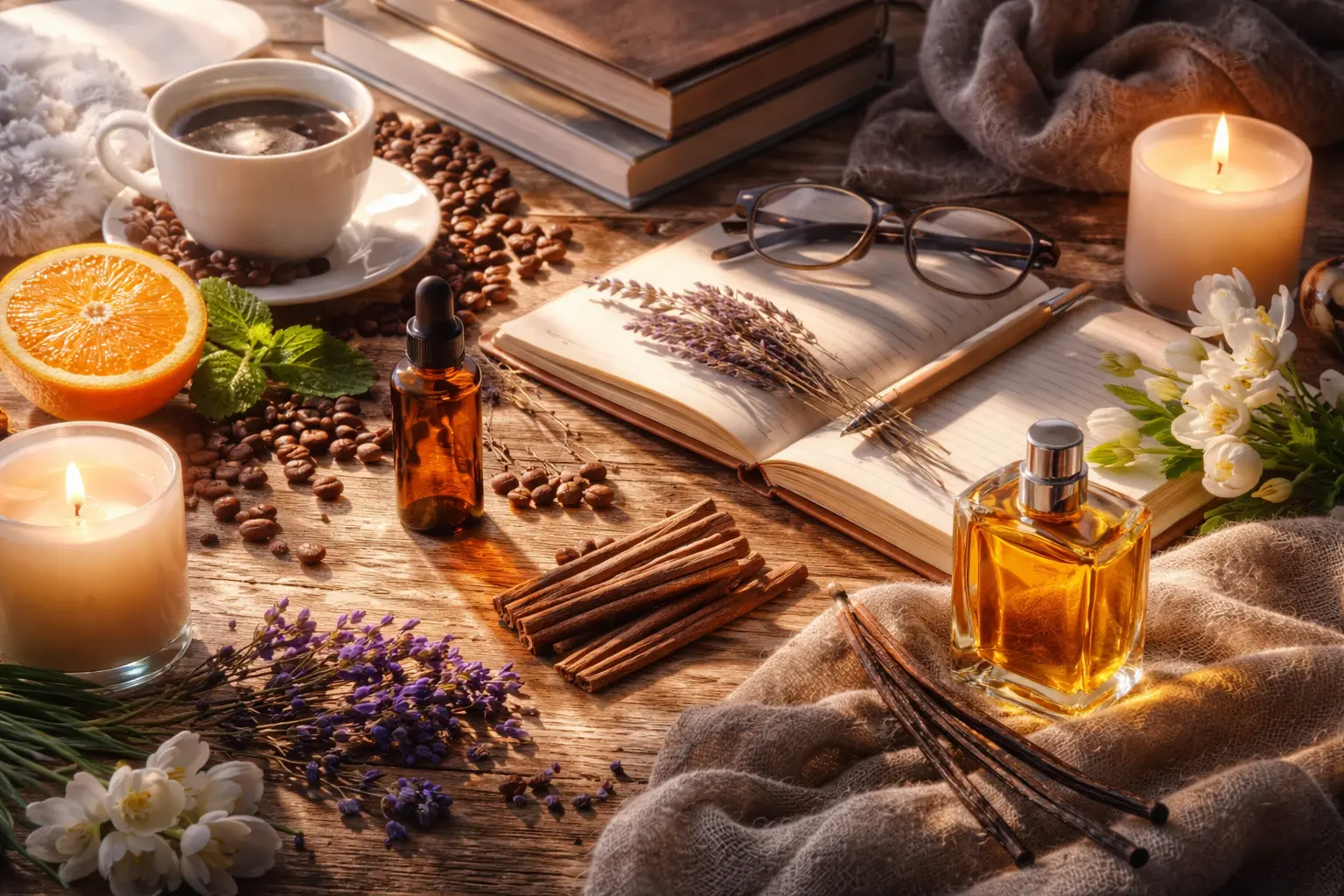
I Tried to Describe My Day Using Only Scents
🧠 What If Your Day Was a Fragrance?
Most of us describe our day using words—busy, stressful, productive, or calm. But what if language wasn’t the best tool for the job?
What if your entire day could be translated into a sequence of scents?
This idea isn’t just poetic—it’s rooted in how our brain processes smell. Unlike sight or sound, scent is directly connected to emotional and memory centers, making it one of the most powerful ways to capture experience. If you’ve ever wondered how scent works on a deeper level, a related article on this site, How Perfume Works: The Science Behind Fragrance, Molecules, and Human Smell, explains why smells can feel so immediate and immersive.
So I tried something unusual: I documented my entire day using nothing but scent.
🌅 Morning: Citrus Light and Quiet Energy
The day began with brightness.
Not visually—but olfactorily.
A sharp burst of citrus, like freshly peeled orange zest, mixed with the subtle bitterness of black coffee. The air felt clean, slightly cool, and full of quiet potential.
It wasn’t just a smell—it was a feeling of clarity.
This connection between scent and emotional state isn’t random. It reflects a deeper neurological truth explored in Why Smell Is the Most Emotional Human Sense, where scent bypasses logical filters and speaks directly to how we feel.
Morning, it turns out, doesn’t just look fresh—it smells like it too.
☀️ Midday: Warmth, Movement, and Subtle Chaos
By midday, the scent profile shifted.
Warm air. Skin. Faint traces of wood and fabric. A hint of something metallic from the city. Movement had a smell—one that felt layered and slightly unpredictable.
Lunch added complexity: spices, cooked grains, a fleeting sweetness that lingered just long enough to be noticed.
Then something unexpected happened.
A familiar scent—something in the food, maybe the spice—triggered a memory I hadn’t thought about in years. A place, a moment, a feeling resurfaced instantly.
That moment perfectly reflects what’s explained in Why Scents Trigger Memories—how certain smells act as keys, unlocking deeply stored experiences without warning.
My day wasn’t just happening—it was echoing.
🌆 Afternoon: The Difficulty of Naming the Invisible

This is where things got complicated.
Describing morning scents felt easy. Midday had structure. But afternoon?
It became abstract.
How do you describe the smell of focus? Or the absence of distraction?
There was a faint dryness in the air, a neutral scent with occasional interruptions—paper, electronics warming slightly, the soft trace of fabric.
But words started to fail.
I realized I wasn’t just describing scents—I was struggling to translate them into language. This exact challenge is explored in Why We Struggle to Talk About Smell, where scent exists in a space that words simply weren’t designed to capture.
The more I tried to explain, the more I understood:
Smell is precise. Language is not.
🌙 Evening: Depth, Skin, and Personal Interpretation
As the day slowed, scents became deeper.
Warmer. Closer. More personal.
There was a subtle muskiness in the air—not from perfume, but from skin, fabric, and the accumulated presence of the day itself. Everything felt less defined, more blended.
And then came a final realization:
Even if someone else lived the exact same day, they wouldn’t smell it the same way.
Skin chemistry, environment, perception—all of it changes how scent is experienced. This idea is explored in Why Does Perfume Smell Different On Skin?, showing that scent is never truly universal.
Your day, like your scent, is uniquely yours.
🧩 What This Experiment Revealed
Describing a day through scent isn’t just creative—it’s revealing.
It shows that:
- Experiences are multi-sensory, even when we don’t notice
- Emotions often arrive before words
- Memory is deeply tied to smell
- Language struggles to keep up with perception
Most importantly, it reveals that we don’t just live our days—we absorb them.
And scent might be the most honest record of all.
❓ FAQ: Understanding Daily Life Through Scent
What does it mean to describe a day using scents?
It means translating experiences, emotions, and environments into smell-based impressions instead of visual or verbal descriptions.
Why are scents so strongly connected to memory?
Because the olfactory system is directly linked to the brain’s memory and emotion centers, allowing smells to trigger vivid recollections instantly.
Can two people experience the same scent differently?
Yes. Factors like skin chemistry, environment, and personal history all influence how a scent is perceived.
Why is it hard to describe smells with words?
Unlike sight or sound, scent doesn’t have a well-developed vocabulary, making it difficult to express accurately.
Does thinking in scents improve awareness?
It can. Focusing on smell increases sensory awareness and helps you notice subtle details in your environment.
Before you move on, pause for a second—if you had to describe your entire day using only scents, what would it smell like?
Discover more from Perfume Cultures
Subscribe to get the latest posts sent to your email.