

🧠 Olfactory Fatigue Explained Simply: Why You Stop Smelling Your Own Perfume
Have you ever applied a fragrance, loved it in the first few minutes… and then suddenly, it seemed to disappear?
A few hours later, someone else compliments your scent — even though you can barely smell it anymore.
This isn’t magic. It’s not even about the perfume itself.
It’s something called olfactory fatigue — a natural process in your brain that changes how you perceive scent over time.
Let’s break it down in a simple, scientific, and practical way.
🧬 What Is Olfactory Fatigue?
Olfactory fatigue (also known as nose blindness) happens when your brain stops responding to a smell after continuous exposure.
✔️ You’re still surrounded by the scent
✔️ The fragrance molecules are still present
❌ But your brain stops “registering” them
In other words:
You’re not losing the smell — your brain is ignoring it.
This process begins right from the moment a perfume interacts with your olfactory system, which is fully explained in How Perfume Works: The Science Behind Fragrance, Molecules, and Human Smell. Once scent molecules bind to receptors in your nose, signals are sent to your brain — and that’s where adaptation begins.
🧠 Why Does Your Brain Do This?
Your brain is designed to filter out constant information.
Imagine if you constantly noticed:
- Your own body scent
- The smell of your room
- The air around you
It would be overwhelming.
So your brain prioritizes new and changing smells — and suppresses what it considers “background noise.”
👉 That’s why your perfume fades for you, but not for others.
This same filtering effect also explains why you may enjoy certain scents without fully understanding them, as explored in Why You Like Scents You Can’t Describe. Your brain processes scent emotionally and selectively — not just logically.
⏳ Why Perfume Seems to Disappear (But Doesn’t)
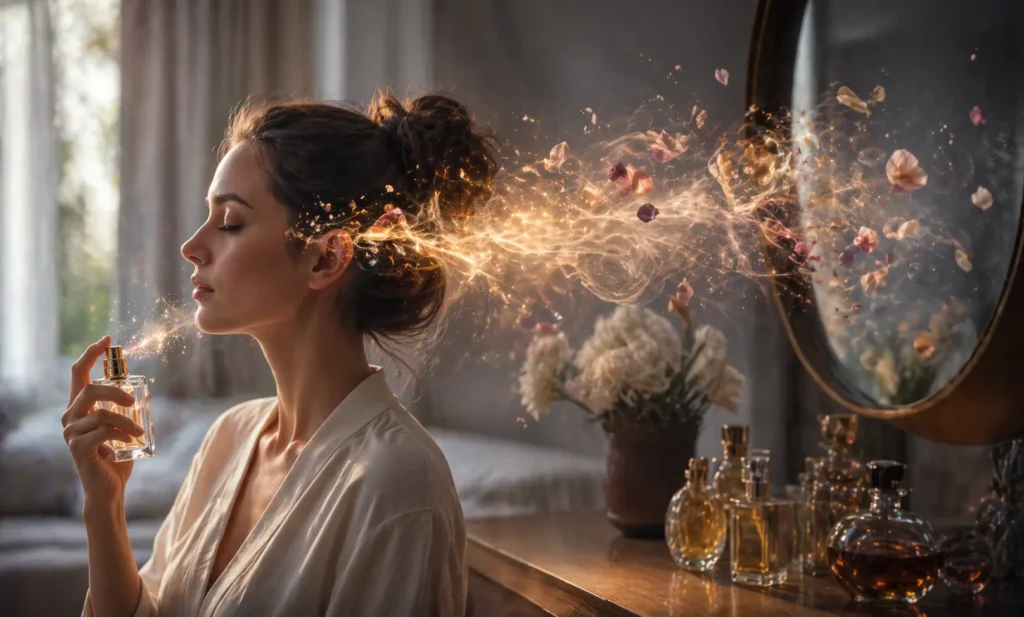
Here’s the key misunderstanding:
❌ “My perfume faded quickly”
✅ “My brain stopped noticing it”
Olfactory fatigue often creates the illusion that a fragrance has weak performance.
But in reality:
- The perfume is still projecting
- Others can still smell it clearly
This is closely related to how longevity works. In How Long Does Perfume Last? Understanding Longevity, the difference between actual evaporation and perceived disappearance becomes clear.
👉 Sometimes the scent fades.
👉 But often, your perception is what changed.
⚡ First Spray vs. Reality
The first few seconds of smelling a perfume are the most intense.
Why?
Because your brain hasn’t adapted yet.
This is why your initial impression can be misleading — a concept explored in Why Your First Impression Of a Perfume Is Often Wrong. What you smell in the first minute is not the full story.
As olfactory fatigue kicks in:
- Bright top notes feel weaker
- The scent seems softer or “gone”
- Your perception shifts dramatically
But the fragrance is still evolving — you’re just less aware of it.
🧬 Why It’s Different for Everyone
Not everyone experiences olfactory fatigue the same way.
Factors that affect it include:
- Skin chemistry
- Scent intensity
- Personal sensitivity
- Environment
For example, in Why Does Perfume Smell Different on Skin?, we see how body chemistry changes how a fragrance develops.
👉 Combine that with olfactory fatigue, and you get a powerful effect:
Two people can wear the same perfume and:
- One stops smelling it after 20 minutes
- The other smells it for hours
🔄 Can You “Reset” Your Nose?
Yes — but not instantly.
Here are a few simple ways to reduce olfactory fatigue:
✔️ Step away from the scent (fresh air helps)
✔️ Avoid repeatedly sniffing the same spot
✔️ Switch between different smells (contrast resets perception)
✔️ Give your nose time — adaptation is temporary
💡 Common myth: smelling coffee beans “resets” your nose
👉 In reality, it works more as a neutral distraction than a true reset.
🧠 The Hidden Impact on Perfume Judgment
Olfactory fatigue affects how you:
- Evaluate perfumes
- Judge longevity
- Decide if something is “weak” or “strong”
This leads to common mistakes:
❌ Overspraying because you “can’t smell it”
❌ Thinking a fragrance has poor performance
❌ Misjudging quality too early
Understanding this concept changes how you experience fragrance entirely.
❓ FAQ: Olfactory Fatigue Explained
❓ Why can others smell my perfume but I can’t?
Because your brain has adapted to the scent and filtered it out, while others are experiencing it as a new smell.
❓ How long does olfactory fatigue last?
It varies, but it can begin within minutes and last as long as you’re continuously exposed to the scent.
❓ Does olfactory fatigue mean my perfume is weak?
No. It often means your perception has changed — not the actual performance of the fragrance.
❓ Can I prevent olfactory fatigue completely?
Not completely. It’s a natural brain function, but you can reduce its effect by limiting continuous exposure.
❓ Why do I smell my perfume again after a while?
Because your brain temporarily “resets” when exposure changes — for example, after moving to a different environment.
🧭 Final Insight
Olfactory fatigue is not a flaw — it’s a feature of human perception.
It protects your brain from overload, but it also distorts how you experience fragrance.
Once you understand it, you stop chasing stronger perfumes…
and start understanding how your senses truly work.
❓ Have you ever thought your perfume disappeared—only for someone else to compliment it hours later? What did that moment change about how you judge fragrances?
Discover more from Perfume Cultures
Subscribe to get the latest posts sent to your email.




One Comment