🧪 Jabir ibn Hayyan: The Father Of Chemistry and His Impact On Perfume Making
✨ Introduction: A Legacy That Smells Like History
When we talk about the origins of modern chemistry and the art of perfume making, one name consistently stands out: Jabir ibn Hayyan. Often referred to as the Father of Chemistry, Jabir’s influence stretches far beyond the laboratory. His groundbreaking methods not only shaped the field of alchemy but also laid the foundations for modern perfume crafting. Understanding his contributions offers a unique glimpse into how science and art intersected centuries ago.
🏺 Who Was Jabir ibn Hayyan?
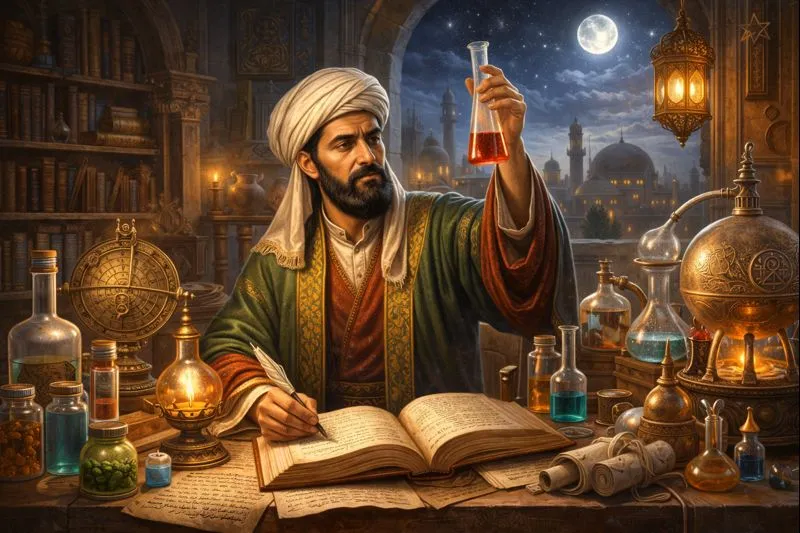
Born in the 8th century in the region now known as Iran, Jabir ibn Hayyan was a polymath: a scientist, alchemist, and innovator. His works combined practical experiments with philosophical insights, creating a bridge between mystical alchemy and empirical science. While alchemy often had spiritual or mystical connotations, Jabir emphasized observation, experimentation, and documentation, which would later become the backbone of modern chemistry.
Jabir is credited with introducing systematic experimentation, refining laboratory equipment, and standardizing chemical processes. His meticulous approach allowed future chemists and perfumers to explore chemical transformations with consistency, rather than relying solely on trial and error.
🔬 Jabir’s Pioneering Work in Chemistry
Jabir ibn Hayyan authored over 300 treatises, covering a range of topics from metals and minerals to acids and distillation techniques. Among his most significant contributions were:
- Distillation Processes: Jabir improved the alembic, a device essential for separating liquids and extracting essential oils. This innovation is directly tied to perfume extraction today.
- Acids and Solvents: He described sulfuric acid, nitric acid, and aqua regia, paving the way for chemical reactions that could isolate aromatic compounds.
- Purification Techniques: Jabir introduced crystallization, sublimation, and filtration methods, which later allowed perfumers to refine essential oils with greater purity.
By formalizing these processes, Jabir transformed alchemy from mystical speculation into a practical science, laying the groundwork for the creation of high-quality perfumes.
🌹 The Connection Between Chemistry and Perfume Making:
Perfume making has always been a blend of art and science. Before Jabir ibn Hayyan, scents were often extracted through rudimentary methods like maceration or simple infusion. Jabir’s innovations in distillation and purification revolutionized the field:
- Distillation of Essential Oils: Using his alembic designs, perfumers could extract concentrated oils from flowers, herbs, and resins, which enhanced the longevity and intensity of fragrances.
- Chemical Stability: Jabir’s work on acids and solvents provided tools to preserve aromatic compounds, ensuring perfumes remained fragrant over time.
- Refinement Techniques: Sublimation and crystallization allowed perfumers to isolate specific scent molecules, leading to more complex and harmonious blends.
Without Jabir’s scientific contributions, the sophisticated perfumes we enjoy today—like rose, jasmine, or oud-based fragrances—might have remained elusive.
🏺 Historical Influence on Perfume Traditions:

Jabir’s influence extended beyond the laboratory. His methods spread across the Islamic world and eventually reached Europe during the Middle Ages. Several notable impacts include:
- Islamic Golden Age Perfumes: Cities like Baghdad and Cairo became hubs for perfume innovation, using Jabir’s distillation techniques to create refined scents for palaces and mosques.
- Medieval Europe: Arabic texts on chemistry, translated into Latin, inspired European alchemists and early perfumers, linking Jabir’s work to the development of modern European fragrances.
- Cultural Significance: Perfumes became not just luxury items but also tools for rituals, medicine, and personal hygiene, demonstrating the interdisciplinary value of Jabir’s contributions.
🧴 Jabir’s Legacy in Modern Perfume Brands:
Today, many perfume houses indirectly benefit from Jabir ibn Hayyan’s discoveries. High-end brands like Chanel, Dior, and Tom Ford rely on techniques that stem from centuries-old chemical innovations:
- Extraction Methods: Steam distillation and solvent extraction are foundational processes in modern perfumery.
- Molecular Understanding: Contemporary perfumers analyze essential oils at the molecular level—a concept rooted in Jabir’s systematic approach to chemicals.
- Art-Science Fusion: The balance of fragrance creation—combining sensory artistry with chemical precision—echoes Jabir’s philosophy of integrating science and experimentation.
🧭 The Broader Impact of Jabir’s Work:
Jabir ibn Hayyan’s impact goes beyond perfumes. His methodologies influenced pharmaceuticals, cosmetics, and even the early development of chemical engineering. His insistence on accurate measurement, experimentation, and documentation created a legacy that empowered future scientists and artisans alike.
Moreover, Jabir’s work reminds us that innovation is timeless. Techniques he pioneered over a millennium ago still inform contemporary practices, proving that the intersection of science and creativity is eternal.
📝 Key Takeaways
- Jabir ibn Hayyan, born in the 8th century, is the Father of Chemistry.
- He developed distillation, crystallization, and purification techniques that revolutionized perfume making.
- His work influenced perfume traditions in the Islamic world and Europe.
- Modern perfume brands still benefit from his innovations in extraction and chemical refinement.
- Jabir’s legacy demonstrates how science and art can merge to create enduring cultural and technological advancements.
💡 Final Thoughts
Understanding Jabir ibn Hayyan is essential for anyone passionate about perfume, chemistry, or history. His pioneering spirit demonstrates that every bottle of perfume carries centuries of scientific exploration. Next time you enjoy a fragrant rose or exotic oud, remember the medieval chemist whose work made such olfactory artistry possible.
🧭 Internal Linking with Contextual Call-to-Action: Curious about how ancient civilizations influenced modern perfume ingredients? Check out our article “Did Ancient Persian Civilization Use Perfumes?” to explore more historical perfume secrets.
Which modern perfume do you think best embodies the blend of science and art that Jabir ibn Hayyan started centuries ago? Share your thoughts in the comments below!
Discover more from Perfume Cultures
Subscribe to get the latest posts sent to your email.