
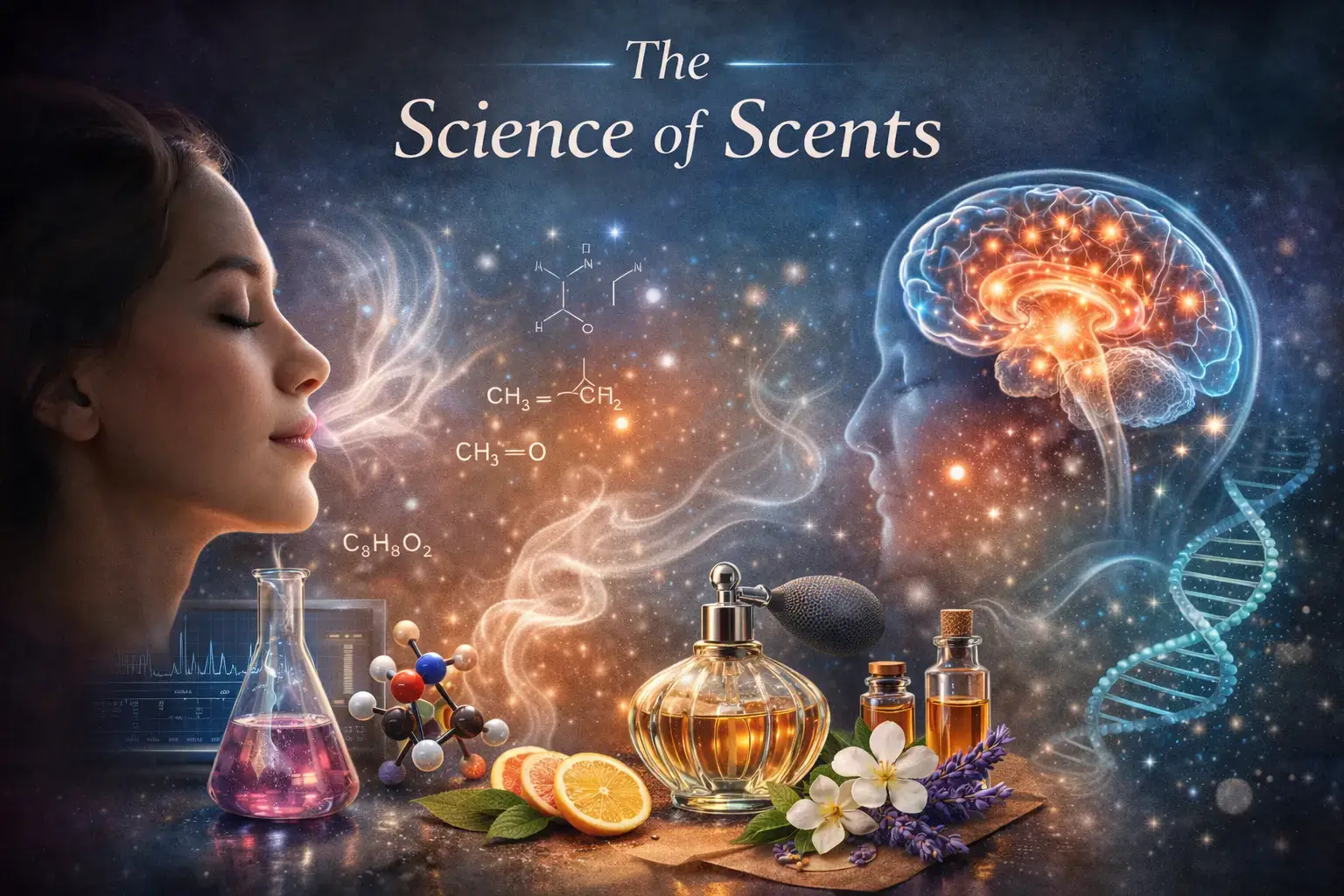
🧠 What Is The Science Of Scents?
Scents are more powerful than we often realize. A single whiff can transport us back to childhood, trigger attraction, or instantly change our mood. But what exactly happens behind the scenes when we smell something? The answer lies in a fascinating field known as the science of scents—a blend of biology, chemistry, and psychology that explains how fragrances interact with the human brain.
In this article, we’ll explore how scents work, why they affect emotions so strongly, and how this science shapes modern perfume creation.
👃 How the Human Sense of Smell Works:
The journey of scent begins in the nose, but its true destination is the brain.
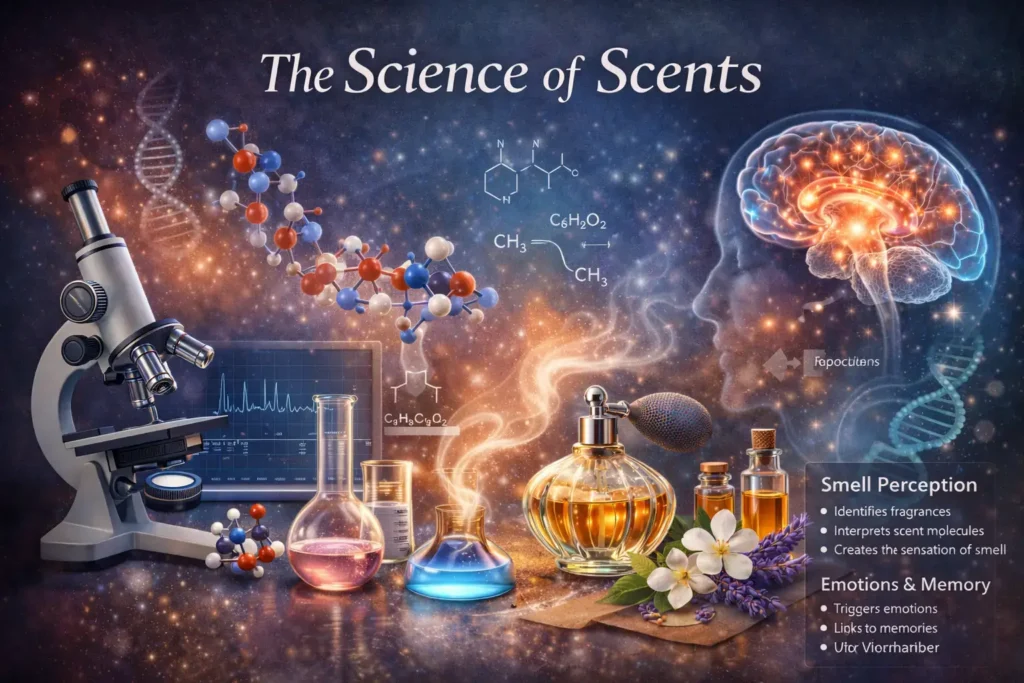
When you inhale, microscopic scent molecules travel through the air and enter your nasal cavity. These molecules bind to specialized cells called olfactory receptors, located high inside the nose. Humans have around 400 different olfactory receptors, each designed to detect specific molecular structures.
Once activated, these receptors send electrical signals directly to the brain—specifically to the olfactory bulb, which processes smells faster than any other sense.
This direct neural pathway explains why scent perception feels immediate and intense compared to sight or sound.
🧬 The Chemistry Behind Scents:
At its core, scent is chemistry.
Every fragrance is made of volatile chemical compounds—meaning they evaporate easily and can be detected by the nose. These compounds differ in:
- Molecular size
- Shape
- Functional groups (like alcohols, esters, or aldehydes)
The brain interprets these chemical signatures as specific smells. For example:
- Limonene smells citrusy
- Vanillin smells sweet and creamy
- Eugenol smells spicy and clove-like
This is why perfumery relies heavily on organic chemistry, whether working with natural essential oils or synthetic aroma molecules.
🧠 Why Scents Are Linked to Memory and Emotion:
One of the most fascinating aspects of the science of scents is its deep emotional impact.
Unlike other senses, smell signals bypass the rational thinking centers of the brain and connect directly to the:
- Amygdala (emotion)
- Hippocampus (memory)
This is known as the Proust Effect, named after the writer Marcel Proust, who described how a smell could unlock vivid memories.
That’s why:
- A perfume can remind you of a specific person
- A familiar scent can instantly calm or energize you
- Certain fragrances feel comforting without knowing why
Modern perfume brands intentionally use this science to create emotionally resonant fragrances.
🌸 Natural vs Synthetic Scents: Is There a Difference?
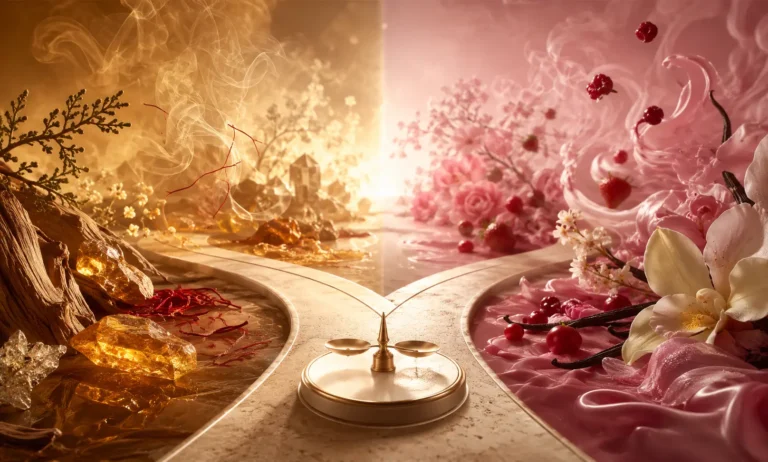
A common misconception is that natural scents are always better than synthetic ones. Scientifically, the reality is more nuanced.
🌿 Natural Scents
- Derived from plants, flowers, woods, or resins
- Complex and multi-layered
- Can vary depending on climate and harvest
🧪 Synthetic Scents
- Created in laboratories
- Highly stable and consistent
- Can replicate rare or endangered natural aromas
In modern perfumery, both are essential. Many iconic fragrances rely on a blend of natural and synthetic molecules to achieve balance, longevity, and safety.
🧪 The Science of Perfume Structure:
Perfumes are not random blends—they are carefully engineered systems.
Most fragrances are built using a three-layer structure:
| Layer | Description | Purpose |
|---|---|---|
| Top Notes | Light, fast-evaporating molecules | First impression |
| Heart Notes | Medium-weight molecules | Core identity |
| Base Notes | Heavy, slow-evaporating molecules | Longevity and depth |
This structure is based on evaporation rates, a key concept in scent science. As lighter molecules disappear, heavier ones take over—creating a dynamic scent experience over time.
🌿 How the Brain Interprets “Good” and “Bad” Smells:
Why do some scents smell pleasant while others don’t?
The answer lies in evolutionary biology.
Historically:
- Pleasant scents often signaled food, safety, or fertility
- Unpleasant scents warned of danger, decay, or toxins
However, cultural conditioning also plays a role. A scent considered beautiful in one culture may be neutral or even unpleasant in another.
This combination of biology and learned experience makes scent perception highly personal—one reason why perfume preferences vary so widely.
🧠 Scent, Mood, and Behavior:
Scientific studies show that scents can influence behavior in subtle but powerful ways:
- Lavender: promotes relaxation and reduces stress
- Citrus: increases alertness and positivity
- Vanilla: creates comfort and emotional warmth
- Woody notes: evoke confidence and stability
This is why scent science is used not only in perfumery, but also in:
- Retail environments
- Hotels and spas
- Product branding
Fragrance is no longer just aesthetic—it’s psychological design.
🔬 How Modern Technology Shapes the Science of Scents:
Today, scent science is evolving rapidly thanks to technology.
Modern tools include:
- Gas Chromatography-Mass Spectrometry (GC-MS) to analyze scent molecules
- AI-assisted fragrance design to predict appealing scent combinations
- Biotechnology to create sustainable aroma compounds
These innovations allow perfume brands to design scents with precision, consistency, and reduced environmental impact—while still evoking natural beauty.
🌍 Why the Science of Scents Matters More Than Ever:
As consumers become more conscious, they want to understand what they wear on their skin.
The science of scents helps:
- Improve fragrance safety
- Enhance personalization
- Support sustainable perfume practices
It also explains why scent remains one of the most intimate and powerful forms of self-expression.
Perfume is no longer just art—it’s applied neuroscience.
If you’re intrigued by how science meets creativity, you’ll enjoy exploring how natural materials influence fragrance design.
👉 Read next: “The Hidden Power Of Aromatic Herbs in Perfume Making” to see how plant chemistry shapes modern perfumes.
Have you ever smelled a fragrance that instantly changed your mood or brought back a vivid memory?
👉 Share your experience in the comments—what scent affected you the most, and why?
Discover more from Perfume Cultures
Subscribe to get the latest posts sent to your email.


One Comment