How to Tell if a Baccarat Rouge 540 Sample Is Authentic
🔥A Tiny Sample Can Carry a Very Expensive Question
Buying a Baccarat Rouge 540 sample is supposed to reduce risk.
Instead of spending hundreds of dollars on a full bottle, you spend a relatively small amount, wear the fragrance several times, and decide whether the scent deserves a place in your collection.
But there is one problem:
What if the sample itself is not authentic?
That question becomes especially important with Baccarat Rouge 540 because samples sold online do not all come in the same format. Some are official manufacturer samples. Others are legitimate decants transferred from authentic retail bottles. Some sellers use the word “sample” loosely—and some listings may not be as trustworthy as they first appear.
The good news is that you do not need to authenticate a Baccarat Rouge 540 sample from one tiny detail.
In fact, relying on one detail is usually the wrong approach.
The smarter method is to combine several pieces of evidence:
- where the sample came from,
- whether it is an official sample or a decant,
- how clearly the seller represented it,
- whether the packaging makes sense for that format,
- whether the price is commercially plausible,
- whether the scent develops as expected,
- and whether multiple red flags appear together.
The goal is not to become a perfume detective capable of declaring Baccarat Rouge 540 real or fake from one spray.
The goal is much more practical:
Can you trust this sample enough to let it influence an expensive full-bottle purchase?
That is the standard that matters—and this guide will show you how to reach that decision with far more confidence.
🔎 How Can You Tell if a Baccarat Rouge 540 Sample Is Authentic?
To tell if a Baccarat Rouge 540 sample is authentic, evaluate the seller, sample type, packaging, labeling, price, scent development, and performance together rather than relying on one sign. An official sample and a third-party decant can look very different while both containing authentic fragrance. Suspicious packaging, an unreliable seller, an implausibly low price, and a scent that behaves completely unlike Baccarat Rouge 540 become more meaningful when several warning signs appear together.
The most important principle is simple:
Authenticity should be judged through a pattern of evidence, not one isolated detail.
A genuine decant may arrive in a plain atomizer with a simple label because the fragrance was transferred from an authentic bottle by a third party.
Meanwhile, an attractive-looking vial does not automatically guarantee that the liquid inside is genuine.
That distinction is why the first step should always be identifying what kind of sample you actually purchased.
🧪 Step 1: Determine Whether You Bought an Official Sample or a Decant
Before examining fonts, labels, atomizers, colors, or scent performance, establish what the seller claimed to be selling.
An official manufacturer sample is generally presented as a branded sample produced or distributed through the fragrance house or its authorized channels.
A decant is different. The fragrance is taken from a larger bottle and transferred into another vial or atomizer.
Both can be perfectly legitimate ways to experience Baccarat Rouge 540.
But they should not be authenticated using exactly the same criteria.
If you are still unsure how these formats differ, the detailed guide to Baccarat Rouge 540 Sample vs Decant: What Is the Difference? explains why packaging expectations, sizes, presentation, and buying risks can differ significantly.
For example, a plain 2ml glass atomizer from a reputable decant seller should not automatically be considered fake because it lacks Maison Francis Kurkdjian retail packaging.
It was never supposed to look like an official manufacturer sample.
Conversely, if a seller explicitly describes something as an official Maison Francis Kurkdjian sample, then the branding and presentation deserve considerably more scrutiny.
Comparison Table: Official Sample vs Decant
| Factor | Official Sample | Third-Party Decant |
|---|---|---|
| Original branded presentation | Usually expected | Usually not expected |
| Fragrance transferred by seller | No | Yes |
| Plain generic atomizer possible | Less likely | Completely normal |
| Seller reputation matters | Yes | Extremely important |
| Packaging useful for authentication | More useful | Less useful |
| Can contain genuine BR540? | Yes | Yes |
| Lack of retail-style packaging means fake? | Potential concern | No |
The practical takeaway is important:
Do not accuse a decant of being fake simply because it does not look like an official sample.
With decants, the chain of trust becomes much more dependent on the seller.
🛒 Step 2: Investigate the Seller Before You Investigate the Liquid
The seller is often one of your strongest authenticity signals.
That may sound less exciting than analyzing the color of the fragrance under bright light, but commercially it is far more useful.
Ask:
- Does the retailer clearly identify what it is selling?
- Does it distinguish official samples from hand-decanted fragrance?
- Does it have transparent customer-service information?
- Are product sizes clearly stated?
- Does it explain where its decants originate?
- Are there meaningful buyer reviews?
- Does it have sensible refund or dispute procedures?
- Are prices realistic?
- Does the website appear built around legitimate fragrance retail rather than anonymous bargain listings?
A trustworthy seller should make the buying process more transparent, not more mysterious.
When shopping has not happened yet, source selection is one of the easiest risks to control. Our guide to Where to Buy Baccarat Rouge 540 Samples Online focuses specifically on choosing a source before money changes hands.
This matters because once a third party transfers perfume into an unbranded atomizer, you lose many of the physical clues available on a full retail bottle.
You are therefore buying not only liquid.
You are buying confidence in the seller’s supply chain.
🚩 Step 3: Look for Red Flags—but Do Not Let One Red Flag Decide Everything
Authenticity becomes more questionable when multiple warning signs appear together.
Some of the most useful red flags include:
🚩 The seller makes vague claims about the sample’s origin
Descriptions such as “100% original” are not especially valuable on their own.
More useful information includes whether the item is an official sample or a decant, the amount supplied, how it was transferred, and what presentation the buyer should expect.
🚩 The seller intentionally blurs the line between a decant and an official sample
A seller using its own atomizer is not inherently problematic.
Representing that atomizer as an official manufacturer sample when it is not is a much bigger concern.
🚩 The price appears irrationally low
Discounting exists.
Small samples also have unusual cost-per-milliliter economics.
But when an expensive fragrance is being offered at a price that makes little commercial sense, the low price should increase—not eliminate—your scrutiny.
🚩 Product photographs do not match the description
If the listing talks about an official carded sample while the photos show generic atomizers, ask questions before purchasing.
🚩 There is no useful seller history
A new seller is not automatically dishonest, but an anonymous seller with no reputation, no meaningful product information, no buyer protection, and unusually low pricing creates several risks simultaneously.
🚩 The fragrance seems completely unrelated to Baccarat Rouge 540
A slight difference is not enough.
A dramatically different fragrance experience combined with other warning signs deserves much more attention.
📊 Which Signs Should You Trust Most?
Not all authenticity clues deserve equal weight.
| Authenticity Signal | How Useful Is It? | Why |
|---|---|---|
| Seller reputation and transparency | Very high | Establishes trust before physical inspection |
| Correct identification as sample or decant | Very high | Determines what packaging should look like |
| Multiple packaging inconsistencies | High for official samples | More meaningful when presentation should be standardized |
| Unrealistically low pricing | Medium–high | Stronger when combined with other warning signs |
| Scent development | Medium | Useful, but subjective and affected by many variables |
| Longevity/projection | Medium | Helpful but affected by anosmia, skin, climate, dosage, and storage |
| Liquid color alone | Low | Color can vary and is easy to overinterpret |
| One unusual spray | Very low | Too little information for a meaningful judgment |
This table illustrates why the internet habit of authenticating a fragrance from one photograph or one smell impression can be misleading.
📦 Step 4: Examine the Packaging in the Context of What You Bought
Packaging inspection is most useful when you are dealing with an official sample.
Look for obvious inconsistencies such as:
- poor print quality,
- obvious spelling mistakes,
- crooked or unusually crude labels,
- questionable construction,
- branding that appears inconsistent,
- or a presentation that does not match what the seller promised.
But there is an important limitation:
Packaging knowledge should be used to identify inconsistencies, not to create absolute certainty from tiny manufacturing details.
Packaging can change over time.
Different markets can receive different presentation formats.
A sample may have been separated from a larger discovery set or promotional presentation.
That is also why full-bottle authentication involves additional checks that cannot always be applied to tiny samples. If you later need to authenticate a retail bottle, use the more comprehensive How to Tell if Baccarat Rouge 540 Is Real or Fake guide rather than assuming sample-level checks are sufficient.
💰 Step 5: Ask Whether the Price Makes Commercial Sense
Price alone cannot authenticate perfume.
But price is useful context.
Suppose one reputable seller charges a reasonable premium for a small decant because it must purchase an expensive retail bottle, supply atomizers, handle fulfillment, process payments, and ship individual orders.
Then another unknown seller appears offering significantly more fragrance for dramatically less money.
That does not mathematically prove the cheaper sample is counterfeit.
But it gives you a reason to investigate.
Think about price as a risk multiplier.
A low price from a respected retailer during a promotion may be perfectly plausible.
An extreme bargain from an anonymous marketplace seller with poor photos and vague sourcing is a very different buying proposition.
For shoppers concerned about counterfeit risk before placing an order, How to Avoid Fake Baccarat Rouge 540 Online covers the broader precautions worth taking when evaluating online listings.
The goal is not to pay the highest price possible.
It is to avoid saving $10 on a sample only to use unreliable liquid to make a $300-plus fragrance decision.
👃 Step 6: Does the Sample Actually Smell Like Baccarat Rouge 540?
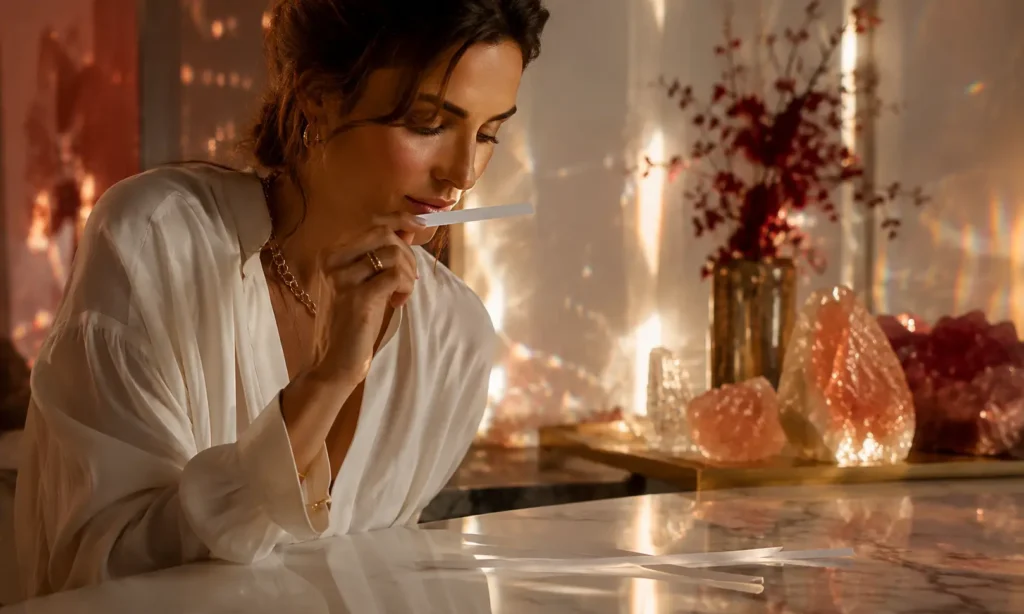
Does the sample really smell like Baccarat Rouge 540Now we reach the test most buyers naturally want to perform.
And it is useful—but less definitive than many people assume.
Baccarat Rouge 540 is famous for an unusual scent profile that can be perceived differently depending on the wearer.
Depending on your nose and skin, you may experience impressions such as:
- airy sweetness,
- saffron-like warmth,
- amberwood,
- mineral or metallic facets,
- burnt-sugar associations,
- transparent woods,
- a warm skin-like effect,
- or an almost strangely diffusive sweetness in the surrounding air.
But fragrance perception is subjective.
Someone familiar with Baccarat Rouge 540 may immediately recognize its general DNA.
Someone smelling it for the first time has no reliable personal reference point.
That is why the question should not simply be:
“Does it smell exactly as I imagined?”
Instead ask:
“Does its development make sense compared with reliable descriptions and previous verified experiences?”
👃 Does a Different Smell Mean Your Baccarat Rouge 540 Sample Is Fake?
No. A Baccarat Rouge 540 sample smelling different from another sample or full bottle does not automatically mean it is fake. Differences can come from skin chemistry, spray amount, storage, atomizer performance, fragrance age, temperature, nose blindness, and differences between testing from a tiny vial and spraying from a full bottle. A major scent mismatch becomes more suspicious only when combined with other authenticity red flags.
This is one of the most important points in the entire article.
People frequently compare a tiny sample with a department-store tester or a friend’s bottle and conclude:
“They smell different, therefore one must be fake.”
That conclusion is too fast.
Even when the liquid is genuine, your wearing experience may change because of:
- atomizer output,
- application amount,
- temperature,
- humidity,
- skin condition,
- how long the fragrance has been stored,
- whether the sample has experienced repeated temperature changes,
- and your own olfactory adaptation.
If you specifically experience a mismatch between a sample and a bottle you believe is genuine, read Why Does My Full Bottle Smell Different from a Baccarat Rouge 540 Sample or Decant? before treating the difference as proof of counterfeiting.
⏳ Step 7: Test the Dry Down, Not Just the First Spray
The opening seconds are one of the weakest moments to make an authenticity judgment.
Alcohol evaporation, atomizer behavior, dosage, and temperature can temporarily dominate your first impression.
Instead, wear the sample normally and track how it changes.
A useful test might look like this:
First 5 minutes:
Notice the opening, but do not make a verdict.
30–60 minutes:
Pay attention to the developing structure and how the fragrance begins projecting around you.
2–4 hours:
Evaluate whether the scent retains a coherent Baccarat Rouge 540 character.
Later dry down:
Notice what remains close to the skin or on clothing.
You are looking for coherence, not for an exact stopwatch result.
A genuine fragrance does not have to perform identically on every wearer.
📡 Step 8: Weak Performance Is Not Automatic Evidence of a Fake
This is particularly important with Baccarat Rouge 540.
Some fragrances simply fade gradually.
Baccarat Rouge 540 can create a stranger experience because the wearer may stop noticing it while other people can still detect it.
That makes this statement dangerous:
“I cannot smell my sample after two hours, therefore it must be fake.”
Not necessarily.
Before questioning authenticity, try:
- using a controlled number of sprays,
- testing on both skin and clothing,
- avoiding repeatedly smelling the exact spray location,
- moving into fresh air,
- asking another person whether they can detect it,
- and repeating the test on another day.
Only after consistent testing should weak performance become part of your overall authenticity assessment.
And even then, performance is supporting evidence—not proof.
🎨 Step 9: Do Not Authenticate the Sample by Liquid Color Alone
Fragrance buyers often become alarmed when one sample appears lighter or darker than another.
Color can be informative if something looks radically abnormal, but it should not be treated as a standalone authentication method.
Perfume can change visually because of storage conditions, age, light exposure, and other factors.
Small transparent sample vials can also make color differences appear more noticeable than they would inside a full bottle.
More importantly, genuine bottles themselves do not necessarily produce perfectly identical sensory experiences forever. The broader guide Do All Baccarat Rouge 540 Bottles Smell the Same? explores why small differences should be interpreted carefully before assuming counterfeiting.
So if your sample looks slightly lighter than someone else’s:
investigate—but do not panic.
🧠 Step 10: Separate a Genuine Difference from a Genuine Red Flag
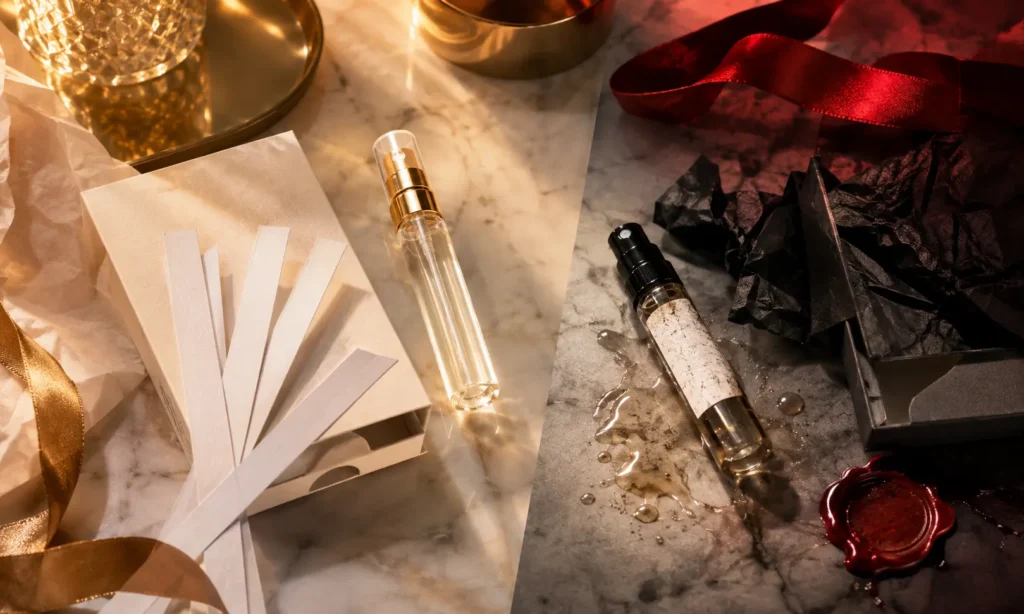
Not every difference is a red flagHere is where good buyer judgment matters.
Probably not enough to call a sample fake:
- the scent seems slightly sweeter than you expected,
- the liquid is somewhat lighter,
- projection feels weaker on one day,
- you become unable to smell it after repeated exposure,
- the decant arrives in a generic atomizer,
- the seller uses its own label,
- or the fragrance develops somewhat differently on your skin.
More concerning when several appear together:
- seller identity is unclear,
- the listing misrepresents a decant as an official sample,
- price appears commercially implausible,
- packaging is poor despite being advertised as official,
- the scent bears little resemblance to expected BR540 characteristics,
- the fragrance behaves inconsistently across repeated tests,
- the seller refuses reasonable questions about sourcing,
- and there is little or no buyer protection.
One clue creates a question.
A cluster of independent warning signs creates a case.
✅ A Practical Authenticity Scorecard
If you already have the sample in front of you, use this simple mental framework.
Seller
Strong confidence: established, transparent seller with clear policies.
Neutral: limited information but nothing obviously suspicious.
Weak confidence: anonymous seller, poor transparency, questionable history.
Product description
Strong confidence: clearly identified as official sample or decant.
Neutral: basic but plausible description.
Weak confidence: misleading or contradictory terminology.
Packaging
Strong confidence: appropriate for the product format.
Neutral: minor differences with plausible explanations.
Weak confidence: multiple serious inconsistencies.
Price
Strong confidence: normal or reasonably discounted.
Neutral: unusually cheap but explainable.
Weak confidence: implausibly cheap combined with other concerns.
Scent
Strong confidence: develops plausibly and consistently.
Neutral: slightly different from expectation.
Weak confidence: radically unrelated scent profile.
Performance
Strong confidence: behaves plausibly over repeated tests.
Neutral: weaker or stronger than expected.
Weak confidence: extremely unusual behavior combined with other warning signs.
The more independent categories that move into the weak-confidence column, the less sensible it becomes to use the sample as your buying reference.
💳 Should You Buy a Full Bottle If You Are Unsure the Sample Is Authentic?
No.
This is where authenticity testing becomes a financial decision rather than merely a fragrance discussion.
The entire purpose of sampling Baccarat Rouge 540 is to reduce uncertainty before committing substantially more money.
If you do not trust the sample, then it has failed at its most important job.
Do not think:
“I already paid for this sample, so I should just decide based on it.”
The sample cost is already spent.
The question now is whether risking hundreds more makes sense.
Usually, it does not.
A better sequence is:
Questionable sample → verify seller → repeat testing → obtain a trusted second sample if necessary → then consider the bottle.
Spending a little more to confirm your impression can be economically smarter than making a large purchase based on unreliable evidence.
🛍️ When Should You Buy a Second Sample from Another Seller?
A second sample is especially useful when:
- the first seller seems questionable,
- the fragrance smells radically different from what you tested in-store,
- your sample performs strangely across several wearings,
- you are deciding between an expensive EDP or Extrait bottle,
- or you simply cannot separate authenticity doubts from scent preference.
The second sample acts as a control.
If both samples from independent reputable sources behave similarly, your confidence increases substantially.
If they smell dramatically different, you now have a legitimate reason to investigate further before buying a bottle.
The important point is that another $10–$20 spent on verification may be insignificant compared with the cost of buying the wrong full bottle.
⚠️ What Should You Do If You Think Your Sample Is Fake?
Do not throw it away immediately.
First:
- Save the listing.
- Photograph the vial and packaging.
- Keep your receipt or order confirmation.
- Review exactly what the seller claimed to provide.
- Compare the sample with another trusted source if economically sensible.
- Contact the seller and ask for clarification.
- Use the marketplace or payment provider’s dispute process if appropriate.
Avoid making public accusations based only on subjective scent impressions.
If you have substantial evidence, document it clearly.
That makes any refund or dispute much easier to support.
🧾 Is an Official Sample Always Safer Than a Decant?
Not necessarily.
Official samples have one major advantage: when obtained through a reliable authorized source, there is less uncertainty about what was transferred and by whom.
But a legitimate decant from a highly trusted fragrance retailer can still be an excellent testing tool.
In some cases, a decant is actually more practical because you can buy enough fragrance for several full wearings rather than relying on a tiny manufacturer sample.
The relevant buying question is therefore not:
“Official sample or decant—which one is automatically authentic?”
It is:
“Which option gives me the strongest combination of trustworthy sourcing, enough fragrance to test properly, and reasonable cost?”
🎯 The Most Important Rule: Authenticate the Buying Chain, Not Just the Vial
Many buyers concentrate almost entirely on physical clues.
But consider two scenarios.
Scenario A
You purchase a plain 3ml atomizer.
The bottle looks generic.
However, the retailer is established, clearly describes the item as a decant, explains how products are rebottled, has a long transaction history, provides customer service, and charges a realistic price.
The plain atomizer should not concern you much.
Scenario B
You purchase an elaborate-looking “official” sample from an unknown seller at a dramatically lower price.
The seller provides almost no sourcing information.
The packaging looks convincing.
Which purchase deserves more trust?
Usually, Scenario A.
Authentication begins before the package arrives.
🏆 What Matters Most Before Spending Money on a Full Bottle?
Your sample does not need to prove authenticity with laboratory certainty.
It needs to give you reasonable buyer confidence.
Before making the larger purchase, you should ideally be able to say:
- I trust where this sample came from.
- I understand whether it is official or decanted.
- I have tested it more than once.
- The fragrance develops plausibly.
- I have no major unresolved authenticity concerns.
- I genuinely enjoy wearing it.
- I understand which concentration I want.
- I am comfortable spending full-bottle money.
That is the standard that matters.
Because ultimately, sampling is not about owning a tiny amount of Baccarat Rouge 540.
It is about making the next purchase smarter.
❓ Frequently Asked Questions
Can a genuine Baccarat Rouge 540 decant come in a generic bottle?
Yes. A decant is fragrance transferred from a larger bottle into a separate vial or atomizer, so generic presentation can be completely normal. The more important issue is whether the seller honestly identifies it as a decant and can be trusted as a source.
Does an authentic Baccarat Rouge 540 sample need a batch code?
Not every small sample or third-party decant will provide the same identification information found on a full retail bottle. Absence of a visible bottle-style batch code therefore should not be used alone to declare a sample fake.
Can fake Baccarat Rouge 540 smell similar to the real fragrance?
A suspicious fragrance may attempt to imitate recognizable aspects of Baccarat Rouge 540, which is another reason scent alone is not sufficient for authentication. Evaluate the seller, product format, pricing, presentation, scent development, and performance together.
Does weak longevity mean my Baccarat Rouge 540 sample is fake?
No. Application amount, skin, clothing, climate, storage, olfactory fatigue, and individual perception can influence perceived longevity. Repeated testing provides more useful information than one wearing.
Why does my sample smell stronger on clothing than on skin?
Fabric and skin interact with fragrance differently. Clothing can retain aromatic materials longer, while skin temperature and chemistry influence evaporation and development. That difference is not evidence of counterfeiting by itself.
Should I buy Baccarat Rouge 540 if I cannot confirm my sample is authentic?
It is usually better to resolve the uncertainty first. Buy another sample from a source you trust or test the fragrance through a reliable retailer before spending substantially more on a full bottle.
Is an extremely cheap Baccarat Rouge 540 sample automatically fake?
No. Promotions, sample size, seller strategy, and product format can affect pricing. However, a price that appears commercially unrealistic becomes an important warning sign when combined with poor seller transparency or other inconsistencies.
What is the strongest indicator that a sample is authentic?
There is no universal single indicator. For most buyers, a trustworthy and transparent source combined with a plausible product format, consistent fragrance behavior, and an absence of major red flags provides the strongest practical confidence.
🏁 Final Verdict: Trust the Evidence, Not One Detail
The safest way to tell whether a Baccarat Rouge 540 sample is authentic is not to hunt for one magical sign.
A generic atomizer does not automatically mean fake.
A slightly different color does not automatically mean fake.
Weak performance on one wearing does not automatically mean fake.
And even a convincing presentation does not automatically guarantee genuine fragrance.
Instead, evaluate the entire chain:
Seller → product type → representation → packaging → price → scent development → performance → consistency.
When those signals align, confidence increases.
When several independent warning signs appear at the same time, stop before making a larger purchase.
That is especially important with Baccarat Rouge 540 because the sample is supposed to protect you from an expensive mistake.
A trustworthy sample does more than tell you whether you enjoy the fragrance.
It gives you enough confidence to decide whether the full bottle deserves your money.
💬 Final Question
Would you trust a cheaper Baccarat Rouge 540 sample from an unknown seller, or would you rather pay more for a sample from a source you already trust before considering the full bottle?
Discover more from Perfume Cultures
Subscribe to get the latest posts sent to your email.




One Comment